Blog Feed from https://bitcoinmagazine.com/ portal.

Bitcoin Magazine

‘Pay 13 Bitcoin or We Blow It Up’: Hyundai Bomb Threat Shakes South Korean Offices

Hyundai Group evacuated employees from two major offices in Seoul today after receiving a bomb threat email demanding payment in bitcoin, police said. 

Authorities later confirmed the threat was a hoax, but the incident added to growing concern over a recent wave of extortion, crypto and non-crypto related, threats targeting South Korea’s largest companies.

According to local reports, a 112 emergency call was received at about 11:42 a.m. The caller relayed the contents of an email sent to Hyundai. The message said an explosive device would be detonated at Hyundai Group’s building in Yeonji-dong, Jongno-gu, at 11:30 a.m.

It added that a second bomb would be taken to Yangjae-dong, Seocho-gu, where Hyundai Motor Group maintains a major office.

The email demanded payment of 13 bitcoins. At current bitcoin prices, the amount is valued at about $1.1 million, or roughly 16.4 billion won.

According to reports, the caller said, “If you don’t give me 13 Bitcoins, I will blow up the Hyundai Group building at 11:30 a.m. and then take a bomb to Yangjae-dong and detonate it.”

Hyundai moved to evacuate staff from both locations. Police dispatched special forces units and bomb squads to conduct searches of the buildings. Officers sealed off parts of the surrounding areas while inspections were carried out. No explosive devices were found at either site.

After several hours, authorities concluded the scam threat lacked credibility. Operations at the buildings gradually returned to normal. Police said no payment was made and no injuries or property damage were reported.

South Korean corporate threats and bitcoin crime

The Hyundai incident comes amid a series of similar threats aimed at major South Korean corporations over the past several days. 

On Thursday, posts appeared on Kakao’s customer service bulletin board claiming explosives had been planted at Samsung Electronics’ headquarters in Yeongtong-gu, Suwon, as well as at Kakao’s Pangyo offices and Naver facilities. Those messages also included demands for large cash payments, per reports. 

On December 17, another bomb threat was posted through KT’s online subscription application system. The message claimed an explosive device had been installed at KT’s office in Bundang, Seongnam. 

Police responded by clearing the building and conducting a search. No explosives were discovered in that case either.

Authorities believe the incidents are part of a pattern of digital extortion attempts that rely on fear rather than using real devices or bombs. Investigations are ongoing to identify the individuals behind the threats and trace the origins of the messages, per the local police. 

This post ‘Pay 13 Bitcoin or We Blow It Up’: Hyundai Bomb Threat Shakes South Korean Offices first appeared on Bitcoin Magazine and is written by Micah Zimmerman.

Source: Bitcoin Magazine – Read More

Bitcoin Magazine

Bitcoin Price Will Jump to $143,000 Next Year, Says Citi Bank

The bitcoin price could climb to $143,000 next year as continued adoption through exchange-traded funds and a more accommodating U.S. regulatory backdrop draw new capital into the market, according to a new forecast from Citi.

Analysts at the Wall Street bank set $143,000 as their base-case target for the bitcoin price over the next 12 months. They outlined a bullish scenario that places the price above $189,000, while their bearish case sees the bitcoin price falling to around $78,500 if macroeconomic conditions deteriorate, according to MarketWatch reporting.

The bitcoin price was trading near $88,000 on Friday, down roughly 30% from its late-October peak. The pullback followed a sharp wave of selling after the rally earlier this year, though Citi noted that outflows from spot bitcoin exchange-traded funds have moderated in recent weeks.

“Our forecasts, in particular for bitcoin, rest on an assumption that investor adoption continues with flows into ETFs of $15 billion boosting token prices,” the analysts wrote. The note was led by Alex Saunders, Citi’s head of global quantitative macro strategy.

Citi also pointed to potential regulatory clarity in the United States as a key driver of future demand. The U.S. Senate is negotiating its own version of the House-passed Clarity Act, legislation that would place bitcoin under the oversight of the Commodity Futures Trading Commission. The analysts said clearer rules could encourage broader institutional participation.

The bank’s bearish scenario assumes recessionary pressures and weaker appetite for risk assets. The bitcoin price fell to multi-month lows in November as concerns over high technology valuations and broader macro risks weighed on markets. 

The cryptocurrency shed more than $18,000 that month, marking its largest dollar decline since May 2021 amid heavy investor withdrawals.

Banks are embracing bicoin

Two weeks ago, the Bank of America told its wealth management clients to allocate 1% to 4% of their portfolios to digital assets, signaling a major shift in its approach to Bitcoin exposure. 

The move allowed over 15,000 advisers across Merrill, Bank of America Private Bank, and Merrill Edge to proactively recommend crypto to clients.

Last week, PNC Bank launched direct spot bitcoin trading for eligible Private Bank clients, allowing them to buy, hold, and sell bitcoin natively through its own digital banking platform without using an external exchange. The move was powered by Coinbase’s Crypto-as-a-Service infrastructure.

Bitcoin price analysis

Bitcoin’s latest sell-off underscores a market stuck in consolidation, where positive macro catalysts fail to translate into sustained upside. 

After briefly testing $89,000 on cooler-than-expected U.S. inflation data, bitcoin slid back toward the $84,000 range, extending a correction now entering its second month. The pattern has become familiar: sharp, data-driven rallies followed by quick retracements as sellers defend resistance below $90,000.

Macro signals offer mixed support. November CPI eased to 2.7% year over year, with core inflation at 2.6%, strengthening the case for eventual Federal Reserve rate cuts in 2026. That backdrop helped spark the intraday rally. Yet rising U.S. unemployment and uneven job growth complicate the outlook, reinforcing expectations that the Fed will move cautiously. Markets appear reluctant to price in aggressive easing.

A key drag remains U.S.-listed spot Bitcoin ETFs, which have shifted from consistent inflows to net redemptions. The outflows remove a stabilizing bid that previously absorbed sell pressure, making breakouts harder to sustain even on positive news.

Technically, the bitcoin price is range-bound. Resistance sits just below $90,000, while support near $84,000 is weakening. A decisive break lower could open a move toward the $72,000–$68,000 zone, where analysts expect stronger demand.

Extreme fear readings suggest potential undervaluation, but near-term momentum still favors sellers.

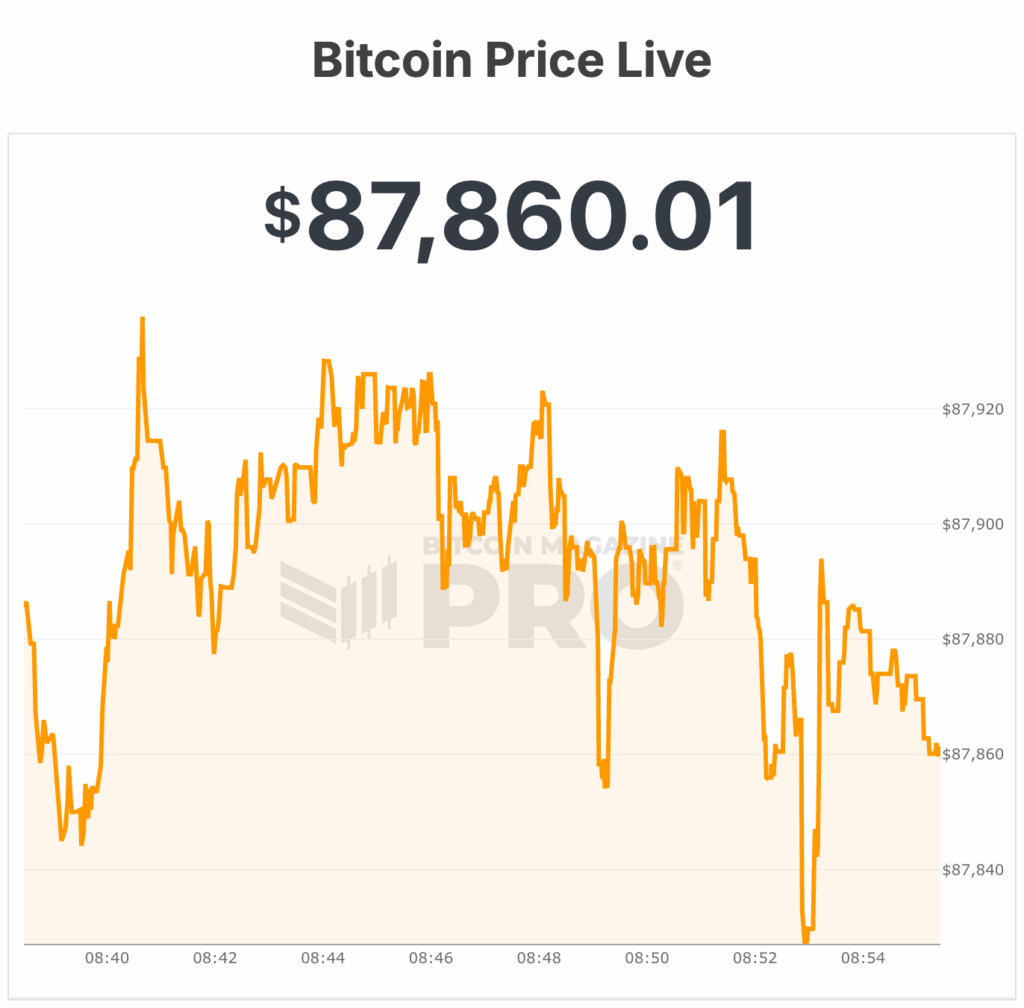
At the time of writing, the bitcoin price is dancing around the $88,000 level.

bitcoin price

This post Bitcoin Price Will Jump to $143,000 Next Year, Says Citi Bank first appeared on Bitcoin Magazine and is written by Micah Zimmerman.

Source: Bitcoin Magazine – Read More

Bitcoin Magazine

SEC Charges Bitcoin Miner for Duping Investors Out of $48.5 Million 

The U.S. Securities and Exchange Commission has charged Danh C. Vo, founder and CEO of bitcoin mining company VBit Technologies Corp., with defrauding investors out of $48.5 million. 

According to the SEC, Vo misused the funds for gambling, cryptocurrency purchases, and gifts to family members, while misleading investors about the operations of his business.

The complaint, filed in the U.S. District Court for the District of Delaware, alleges Vo raised over $95.6 million from approximately 6,400 investors between December 2018 and February 2022. 

He sold “hosting agreements,” which promised investors a share of profits from bitcoin mining rigs operated by VBit. Most customers chose this passive investment option rather than purchasing rigs themselves.

Vo misrepresented how many mining rigs were actually operational, effectively selling more hosting agreements than the company could support. 

“While some investors received returns, others suffered substantial losses,” the complaint stated. Vo either knew or was reckless in not knowing that the company could not meet the obligations tied to the hosting agreements.

Vo, 37, exercised complete authority over VBit, including its promotional materials, website content, and investor account information. 

The SEC said the hosting agreements qualify as securities because investors relied on Vo and VBit’s efforts to generate profits.

SEC: Family members received misappropriated funds

In addition to the misappropriation, Vo allegedly transferred $5 million to family members, including his ex-wife, mother, brother, and sister, the commission said. He reportedly left the U.S. with the remaining misappropriated funds following his divorce in November 2021. 

Several family members are named as relief defendants in the lawsuit and have consented to disgorge the funds they received, pending court approval, per the SEC.

VBit was acquired by Advanced Mining Group in 2022 and is now defunct. The action seeks disgorgement of ill-gotten gains, civil penalties, and a ban on Vo from participating in future securities offerings.

The lawsuit also comes as Congress debates federal measures to address cryptocurrency scams. A bipartisan proposal would create a dedicated task force to identify and address fraud in the digital asset sector.

The SEC said they want Vo’s alleged conduct to be a reminder that investors should carefully evaluate claims of passive income from crypto and confirm that operations are transparent and verifiable.

This post SEC Charges Bitcoin Miner for Duping Investors Out of $48.5 Million  first appeared on Bitcoin Magazine and is written by Micah Zimmerman.

Source: Bitcoin Magazine – Read More

Bitcoin Magazine

Bitcoin Price Crashes to $84,000 – Is $70,000 Next?

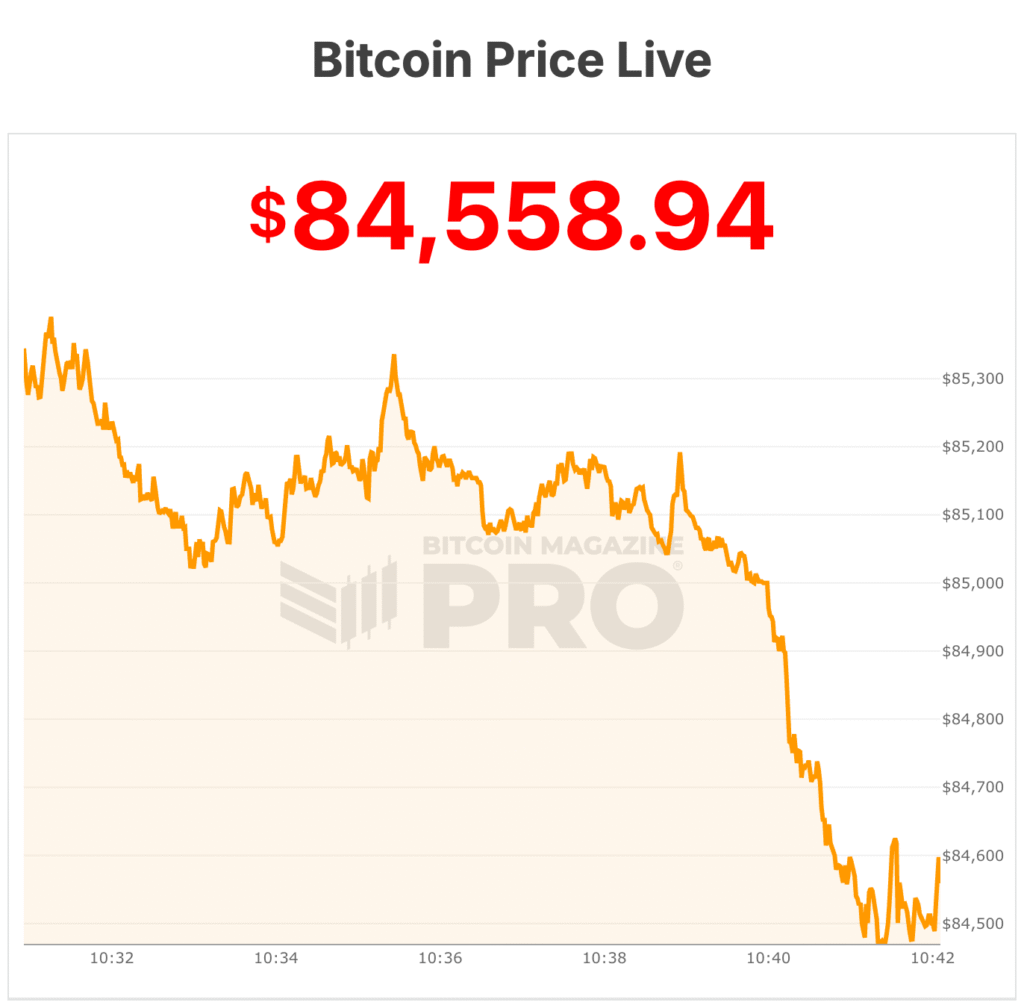
The bitcoin price dropped sharply today after a brief pump near $90,000, sliding to $84,544 as the price sell-off continued into its second month. 

Bitcoin lost 2% over the past 24 hours. It remains 5% below its seven-day high of $89,220 and hovers near the week’s low of $84,596. Trading volume reached $56 billion. Bitcoin’s market capitalization stands at $1.69 trillion. The circulating supply is roughly 19.96 million BTC out of a total 21 million, according to Bitcoin Magazine Pro data. 

The drop follows a brief rally that earlier saw the Bitcoin price test $89,000. The surge came after the U.S. released new Consumer Price Index data. Inflation rose 2.7% year over year in November, lower than expected. Core CPI, which excludes food and energy, fell to 2.6%, the lowest since early 2021.

Bitcoin jumped from intraday lows near $86,000 to challenge $89,000. Traders viewed the cooler inflation report as a potential signal for looser Federal Reserve policy in 2026. CME FedWatch data suggested slightly higher odds of a rate cut by March, though January moves remain unlikely.

The rally did not last. The bitcoin price failed to break $90,000 and slid to $84,4000. This pattern is familiar: sharp spikes followed by quick retracements.

What’s dragging down the bitcoin price?

A persistent challenge is U.S.-listed spot Bitcoin ETFs. These funds, once a major source of demand, have seen net redemptions. The outflows remove institutional support that previously helped stabilize the price. Without consistent ETF inflows, breakouts above $89,000 are harder to sustain.

Other economic indicators add uncertainty. Recent labor market data showed U.S. unemployment rising to 4.6%, its highest since 2021. Job growth remains uneven. The mixed signals complicate Federal Reserve policy, suggesting a cautious approach despite easing inflation.

Political factors add to market complexity. President Donald Trump has publicly urged lower interest rates and suggested nominating a Fed chair favoring aggressive easing. Markets have largely treated the comments as noise, but the statements add a variable to the macro picture.

Technically, the bitcoin price is consolidating rather than trending. Resistance forms just below $90,000. Supply above this level remains strong, held by investors who bought during prior rallies. 

Analysts at Bitwise recently suggested Bitcoin could break its historical four-year cycle. The firm noted BTC might reach new all-time highs in 2026 with lower volatility and reduced correlation to equities.

The Bitcoin Fear and Greed Index currently sits at 17/100, signaling extreme fear. Historically, readings in this range have coincided with undervaluation. Contrarian investors see potential buying opportunities, though sentiment remains cautious.

Is $70,000 next? 

Technical analysts from Bitcoin Magazine wrote earlier this week that the $84,000 support level is under pressure. If the bitcoin price falls below this point, it could test the $72,000 to $68,000 zone. Initial bounces are expected, but a break below $84,000 could trigger faster declines toward $70,000.

Bitcoin’s price may drop to the $72,000–$68,000 support zone after breaking the $84,000 level, with bears currently in control. A strong bounce is likely from that lower zone, potentially retesting $84,000, though the 4-Year Cycle suggests further downside could occur later in 2026.

Resistance extends from $94,000 to $118,000. Bulls will need substantial buying volume to break above these levels, per Bitcoin Magazine analysts. 

Short-term momentum favors sellers. Last week, the Bitcoin price closed the weekly candle in red, failing to sustain gains near $94,000. Bears are well-positioned to push prices lower this week. 

At the time of writing, the bitcoin price is $84,812. Trading volume reached $56 billion. Bitcoin’s market capitalization stands at $1.69 trillion. The circulating supply is roughly 19.96 million BTC out of a total 21 million, according to Bitcoin Magazine Pro data. 

Bitcoin price

This post Bitcoin Price Crashes to $84,000 – Is $70,000 Next? first appeared on Bitcoin Magazine and is written by Micah Zimmerman.

Source: Bitcoin Magazine – Read More

Bitcoin Magazine

Ledn Publishes Industry-First Monthly Loan Book and Proof of Reserves Data

Ledn, one of the world’s largest bitcoin lenders, announced its Open Book Report, a reserves transparency benchmark designed to expose the kind of risk that caused the 2022 FTX-driven crypto crash. 

According to a press release shared with Bitcoin Magazine, “Traditional lenders (including Citi, JPMorgan, Wells Fargo, BNY Mellon, Schwab, and Bank of America) are reportedly entering the space amid a regulatory vacuum in terms of rehypothecation practices and proof of reserves.” With the passing of the GENIUS Act, which greenlit treasury-backed stablecoins, Wall Street now has a road to service the crypto market and even upgrade its own rails and infrastructure. 

But there are still those who call for clearer regulatory structure for crypto counter parties, Ledn points out that “Global rules on crypto capital requirements & proof of reserves remain in flux, with the US and UK refusing to implement Basel’s proposed framework,” adding that “IOSCO is pushing regulators to hold crypto custody and lending to the standards of traditional finance, yet almost no institution has disclosed how bitcoin collateral is managed, whether it’s rehypothecated, or what happens in a liquidation scenario.” 

John Glover, Chief Investment Officer at Ledn and former Managing Director at Barclays, explained that “If lenders do not have to disclose how they use client collateral, the clients become the leverage. We saw what happened when BlockFi, Celsius, and Voyager operated in the dark. The difference now is that the balance sheets are bigger.” He warned that “This is how we get a 2022-style lending crisis at institutional scale.”

Ledn’s Open Book Report, launched today, showcases “the industry’s longest-running Proof of Reserves,” according to the press release. The report exposes Ledn’s BTC loan book, collateral levels, and aggregate loan-to-value ratios. According to the report, the Network Firm LLP, a U.S.-based certified public accounting firm, independently audited & confirmed that 100% of collateral is held in custody.

The report also reveals “$868 million in outstanding BTC-backed loans, with 18,488 BTC in collateral posted, held 100% BTC in custody; all BTC collateral is held in on-chain addresses and/or custodial accounts.” Ledn’s average loan-to-value ratio stands at 55%, an aggregate LTV well below industry liquidation thresholds. Since 2018, the company has funded “$10.2 billion in lifetime loans across 47,000 originations.”

This framework looks to move the industry past one-off snapshots—starting with monthly disclosures and laying the groundwork for more continuous, real-time transparency over time. Unlike self-reported wallet addresses, Ledn’s approach combines monthly reporting on loan book metrics—including outstanding loans, collateral posted, and average LTV—with reporting from The Network Firm LLP. Ledn also maintains Proof of Reserves attestations on a semiannual basis (every two quarters), confirming that assets exceed client liabilities, with “Merkle tree methodology” enabling clients to confirm their balances were included.

While some companies have announced “proof of reserves” by publishing wallet addresses, Glover argues this falls short. “True transparency requires independent reporting, regular updates, and methodologies anyone can check,” said Glover. “Clients shouldn’t have to take anyone’s word for it.”

Ledn recently received a strategic investment from Tether and has an impeccable track record of protecting client assets across its loan originations, surviving the 2022 crypto lender crisis, and at least one other bear market before that. 

The press release warns that “as traditional financial institutions accelerate their entry into bitcoin-backed lending, Ledn’s Open Book Report establishes the baseline against which these new entrants should be held, before regulators mandate it.” 

This post Ledn Publishes Industry-First Monthly Loan Book and Proof of Reserves Data first appeared on Bitcoin Magazine and is written by Juan Galt.

Source: Bitcoin Magazine – Read More

Bitcoin Magazine

BitGo Enables Lightning Network Payments Directly from Custody

BitGo, a digital asset infrastructure company, announced it now offers Bitcoin Lightning Network access directly from its qualified custody platform. The move makes it one of the first companies to provide Lightning payments for institutional custody.

The service aims to give clients faster and cheaper Bitcoin transactions while keeping institutional security standards intact. It builds on BitGo’s earlier self-custody Lightning solution.

The new offering is powered through a partnership with Voltage, a Lightning Network infrastructure provider. Clients can now use Lightning without running their own nodes or managing keys. BitGo and Voltage handle infrastructure, channels, liquidity, and key management.

Through simple APIs, clients can create wallets, send payments, generate invoices, and track transactions. The platform integrates fully with BitGo’s existing wallet infrastructure, policies, and permissions.

Enterprises adopting Lightning usually face challenges like maintaining nodes, channels, liquidity, and keys. BitGo removes these hurdles. Institutions can now access Lightning with minimal setup and zero operational overhead.

BitGo, along with Ripple, Circle, Fidelity Digital Assets, and Paxos, received conditional approval from the OCC to become federally chartered national trust banks.

This shift from state to federal oversight allows them to offer nationwide fiduciary and digital asset custody services, enhancing regulatory clarity, institutional confidence, and the mainstream adoption of cryptocurrencies.

Lightning Network hits an all-time high

This move comes as Bitcoin’s Lightning Network hits a new all-time high of 5,637 BTC in capacity, driven largely by institutional inflows even as broader user adoption and node growth lag. 

Data from AMBOSS shows the surge, concentrated in November and December, surpasses the previous peak from March 2023, signaling renewed confidence among major exchanges like Binance and OKX, which have added significant BTC to Lightning channels.

 Despite rising capacity, the network’s number of nodes and channels remains below historical highs, highlighting a gap between capitalization and widespread use. 

The increase coincides with ecosystem developments, including Tether’s $8 million investment in Lightning-focused startup Speed and Lightning Labs’ release of Taproot Assets v0.7, enabling reusable addresses, auditable asset supplies, and larger, more reliable transactions. 

These upgrades position the Lightning Network as more than a micropayment system, offering potential for higher-value transfers that leverage Bitcoin’s security, speed, and low fees while expanding real-world financial applications on the network.

“By offering institutional access to Lightning directly from custody, we are allowing our clients to focus on innovation instead of infrastructure,” said Mike Belshe, BitGo CEO and co-founder. “We are combining the speed and lower transaction costs of Lightning with the trusted security of BitGo to make bitcoin practical for everyday payments.”

This post BitGo Enables Lightning Network Payments Directly from Custody first appeared on Bitcoin Magazine and is written by Micah Zimmerman.

Source: Bitcoin Magazine – Read More

Bitcoin Magazine

Bitcoin Price Pumps Above $90,000 Then Dumps to $85,000 in 4 Hours

The bitcoin price (BTC) briefly surged above $90,000 early Wednesday in U.S. trading, only to tumble back below $87,000 within minutes, reflecting a fragile and volatile crypto market.

The largest cryptocurrency rallied from roughly $87,000 to above $90,000 around 10:00 a.m EST before rapidly retracing to the $86,500–$87,500 range. 

At the time of writing, Bitcoin price was near $86,000, down over 0.5% over the past 24 hours despite having been higher by more than 3% minutes earlier. 

The swift swings triggered more than $190 million in liquidations across crypto derivatives markets, hitting both long positions — bets on rising prices — worth $72 million, and short positions — bets on declines — totaling $121 million, according to CoinGlass data.

Bitcoin price support during an ‘exhausted market’

Market observers point to the sharp losses in AI-focused technology stocks as a primary factor behind Bitcoin’s erratic moves. Shares of Nvidia, Broadcom, and Oracle dropped between 3% and 6%, dragging the Nasdaq down more than 1% in early trading. 

Contributing to the deflation in AI sentiment, Blue Owl Capital reportedly withdrew from funding a $10 billion Oracle data center project in Michigan, unsettling traders who had leaned on tech optimism to fuel risk appetite.

“I think we’re now seeing an exhausted market,” Hunter Rogers, co-founder of bitcoin yield protocol TeraHash wrote to Coindesk. “In that environment, even mild selling activity pushes the market lower.”

Shrinking liquidity, particularly over weekend trading periods, amplifies these moves, leaving the bitcoin price vulnerable to sharp whipsaws with limited buy-side support.

Bitcoin price downsides 

Technical analysts are closely watching the $80,000–$85,000 range as critical support. Holding this zone could prevent deeper retracement, while a sustained break below it may open the door to further declines. 

Short-term caution, however, remains prevalent. Georgii Verbitskii, founder of crypto investment platform TYMIO, warned to DLnews that a prolonged period of consolidation or correction is a likely scenario, with potential downside moves toward $60,000 or $70,000 possible if current levels fail to hold. 

Mike McGlone, senior commodity strategist at Bloomberg Intelligence, has even suggested Bitcoin could drop as low as $10,000 in 2026, highlighting the divergence of expert opinions on the coming year.

Despite the near-term uncertainty, longer-term narratives remain largely intact. Institutional participation in Bitcoin continues to grow, supported by spot bitcoin ETFs and a more defined regulatory landscape. 

Analysts at Bitwise recently released a report suggesting Bitcoin could break away from its historical four-year market cycle, potentially achieving new all-time highs in 2026 while exhibiting lower volatility and reduced correlation with equities.

The Bitwise report argues that Bitcoin’s historical four-year cycle, tied to halvings and marked by gains followed by pullbacks, may no longer hold. Analyst Matt Hougan noted that the traditional drivers — halving effects, interest rate swings, and leverage-driven booms — are weaker now. 

He cited diminishing halving impact, expected lower interest rates in 2026, and reduced systemic leverage after October 2025’s record liquidations. Greater regulatory clarity is also seen as reducing the risk of major market crashes, potentially altering the cycle.

The firm also challenged the long-standing criticism that BTC is too volatile for mainstream investors.

According to Bitwise, BTC was less volatile than Nvidia stock throughout 2025, a comparison Hougan says underscores the asset’s ongoing maturation.

Data cited in the report shows bitcoin’s volatility has steadily declined over the past decade as its investor base has diversified and traditional investment vehicles like ETFs have expanded access.

Market in ‘extreme fear’

At the time of writing, the Bitcoin Fear and Greed Index sits at 16/100, signaling extreme fear among market participants. This reflects heightened investor anxiety, with many traders potentially overreacting to recent price movements. 

Historically, readings in this range have often coincided with undervalued market conditions, suggesting a contrarian buying opportunity for those willing to navigate the emotional volatility.

Yesterday, the market sat near 11/100 despite a higher bitcoin price point. At the time of writing, the bitcoin price is trading below $86,000. 

bitcoin price

This post Bitcoin Price Pumps Above $90,000 Then Dumps to $85,000 in 4 Hours first appeared on Bitcoin Magazine and is written by Micah Zimmerman.

Source: Bitcoin Magazine – Read More

Bitcoin Magazine

Bhutan Pledges Up to 10,000 Bitcoin to Build New Mega-City

Bhutan has committed up to 10,000 bitcoin to support the long-term development of Gelephu Mindfulness City (GMC), marking one of the most ambitious sovereign uses of bitcoin for national infrastructure and economic development to date.

The Himalayan kingdom unveiled the Bitcoin Development Pledge this week, allocating a portion of its sovereign bitcoin holdings — valued at roughly $860 million to $1 billion at current prices — to back the new special administrative region in southern Bhutan. 

Officials emphasized that the allocation is intended to preserve capital over the long term rather than fund near-term spending through asset sales.

Instead, Bhutan is exploring mechanisms such as collateralized lending, treasury and yield strategies, and intentional long-term holding to finance infrastructure and development while maintaining exposure to bitcoin’s potential appreciation. 

Final decisions on how the assets will be deployed are expected in the coming months, according to the government.

Gelephu Mindfulness City is central to Bhutan’s broader effort to diversify its economy beyond hydropower and tourism, while remaining aligned with the country’s development philosophy centered on sustainability and social well-being. 

The project, launched in 2024, is designed as a future economic hub focused on finance, technology, green energy, healthcare, agriculture, and high-value tourism.

The city spans roughly 1,544 square miles — about 10% of Bhutan’s territory — near the Indian border.

Bitcoin as a commitment to Bhutan’s youth

King Jigme Khesar Namgyel Wangchuck announced the bitcoin commitment during his National Day Address, framing it as a generational investment aimed at creating quality jobs and opportunities for Bhutan’s youth.

“As your King, I must ensure that every Bhutanese is a custodian, stakeholder, and beneficiary of GMC,” he said. “This commitment is for our people, our youth, and our nation.”

A new land policy associated with the project will treat landowners as shareholders in the city’s development, ensuring citizens across all regions share in the economic upside. Since much of the land involved is state-owned, the government says the benefits will be broadly distributed nationwide.

Bhutan’s bitcoin holdings stem from years of state-backed mining operations powered by surplus hydroelectric energy. Beginning around 2019–2020, the country quietly converted excess renewable power into digital assets, positioning itself as one of the earliest sovereign bitcoin miners. Officials say the strategy allows Bhutan to monetize unused energy capacity without increasing environmental impact.

Estimates of Bhutan’s total bitcoin reserves vary by analytics provider, ranging from roughly 6,000 to more than 11,000 BTC, placing the kingdom among the world’s largest sovereign bitcoin holders. 

The bitcoin pledge builds on a broader national blockchain strategy already underway. Bhutan has rolled out crypto-enabled payments across its tourism sector through partnerships with DK Bank and Binance Pay, allowing visitors to pay with more than 100 digital assets at hotels, airlines, and local merchants. More than 100 tourism-related businesses now accept crypto payments.

The country has also introduced TER, a sovereign-backed digital token reportedly supported by physical gold reserves, and recently anchored its national digital identity system on Ethereum, enabling nearly 800,000 citizens to access public services through blockchain-based verification.

GMC itself has designated bitcoin and two other crypto as strategic reserve assets, making it one of the earliest jurisdictions to formally hold multiple cryptocurrencies at the municipal or regional level. 

Green Digital Ltd., the infrastructure firm leading GMC’s development, is focused on green energy-powered data centers and blockchain infrastructure as part of the city’s long-term vision.

Earlier this month, Bhutan also entered a multi-year partnership with Cumberland DRW to support bitcoin reserve management, sustainable mining expansion, and broader digital asset infrastructure, including potential stablecoin initiatives.

At current bitcoin prices, 10,000 BTC would be worth $877,500,000.

CoinDesk reporting helped with the background of this article.  

This post Bhutan Pledges Up to 10,000 Bitcoin to Build New Mega-City first appeared on Bitcoin Magazine and is written by Micah Zimmerman.

Source: Bitcoin Magazine – Read More

Bitcoin Magazine

Bitcoin Miner Hut 8 Secures Google-Backed Deal to Build Up to 2.3 GW of AI Capacity

Hut 8 Corp. announced a sweeping AI infrastructure partnership on Wednesday with AI model developer Anthropic and compute provider Fluidstack, marking a pretty clear signal that the bitcoin miner is pivoting to a large-scale energy and data center developer.

Under the agreement, Hut 8 will develop between 245 megawatts (MW) and up to 2,295 MW of AI-focused data center capacity in the United States, beginning with a flagship project at its River Bend campus in Louisiana. 

The partnership is structured across multiple tranches, creating a pathway to scale from an initial deployment to gigawatt-level infrastructure over time.

The first phase centers on a 245 MW IT deployment at River Bend, supported by roughly 330 MW of utility power. Hut 8 will develop the site, while Fluidstack will operate high-performance compute clusters for Anthropic. Construction of the initial data halls is expected to be completed by early 2027.

Beyond the initial phase, Fluidstack has secured a right of first offer for up to an additional 1,000 MW of IT capacity at River Bend, contingent on further power expansion. 

A third tranche gives Hut 8 and Anthropic the option to jointly diligence and develop up to 1,050 MW of additional capacity across Hut 8’s broader development pipeline.

Financially, the River Bend project is anchored by a 15-year triple-net lease with Fluidstack valued at approximately $7 billion over the base term, with total contract value rising to roughly $17.7 billion if all renewal options are exercised. 

Alphabet-owned Google is providing a financial backstop covering lease payments and certain operating obligations over the base term, underscoring the strategic importance of securing long-term AI compute capacity, per Reuters reporting. 

Hut 8 ($HUT) stock soars

Hut 8 shares surged more than 20% in premarket trading following the announcement, extending a rally that has seen the stock rise roughly 80% year-to-date. 

Investors appear to be rewarding the company’s pivot toward AI infrastructure at a time when access to power, cooling, and suitable real estate has become a bottleneck for leading model developers.

“Scaling frontier AI infrastructure is, at its core, a power challenge,” Hut 8 CEO Asher Genoot said in a statement, emphasizing the company’s “power-first” development strategy. 

He added that the partnership aligns power sourcing, data center design, and compute deployment into a single integrated platform capable of operating at gigawatt scale.

For Anthropic, the deal expands an existing relationship with Fluidstack and provides a new channel for bringing capacity online as demand for advanced models continues to grow.

“Hut 8’s ability to source and deliver infrastructure at scale provides the runway necessary to continue advancing the capabilities of our models,” said James Bradbury, Anthropic’s head of compute.

The agreement also reflects a broader industry shift. Former crypto miners such as Hut 8, CoreWeave, or Bitfarms are increasingly repurposing their energy-heavy infrastructure for AI workloads as demand for Nvidia-powered compute accelerates. 

While execution risk remains — particularly around power delivery timelines and construction— Hut 8’s latest deal positions it among a small but growing group of firms bridging the worlds of energy, AI, and large-scale digital infrastructure.

Hut 8 recently reduced some of its bitcoin holdings by 389 BTC during the last month, standing out among a small group of miners and corporates trimming exposure.

While some firms added modest amounts and ETF flows turned positive, the data points to a split market in which Hut 8 and a few others acted as sellers amid pressure, contrasting with disciplined treasury buyers and programmatic accumulation elsewhere.

At the time of writing, Hut 8 shares are up 17%. Earlier in pre-market trading, shares were up over 25% at times. The price per share is currently $43.75.

This post Bitcoin Miner Hut 8 Secures Google-Backed Deal to Build Up to 2.3 GW of AI Capacity first appeared on Bitcoin Magazine and is written by Micah Zimmerman.

Source: Bitcoin Magazine – Read More

Bitcoin Magazine

Celebrating One Year of Hashrate Redirect™: How Abundant Mines Redefined Uptime and Protected Millions in Client Bitcoin Rewards

Hood River County, Oregon – December 16th, 2025 – This month last year, Abundant Mines quietly began to launch a feature that would go on to change how the bitcoin mining industry defines performance. Today, the company is celebrating the one-year anniversary of Hashrate Redirect™, a pioneering system that ensures clients continue earning bitcoin even when their machines are offline.

For too long, mining providers have misled customers with uptime metrics that measure whether a facility has power, not whether a machine is actually hashing. A rig could be powered off, broken, or awaiting repairs and still count toward a provider’s claimed “98% uptime.” The result is lost bitcoin, lost revenue, and lost trust.

Abundant Mines set out to correct this.

“When we introduced Hashrate Redirect™ a year ago, we didn’t make a big announcement. We simply built the solution we wished had existed when we were clients,” said Beau Turner, Co-Founder and CEO of Abundant Mines. “Twelve months later, the results speak for themselves: our clients continue earning even when their machines are offline, and the industry standard for uptime is shifting toward truth and transparency.”

A Year of Real Results: Uptime That Actually Means Performance

Instead of measuring uptime by whether a building has power or not, Abundant Mines measures rig uptime – the percentage of time an individual machine is hashing and producing bitcoin. When a rig goes offline for repairs, RMA, or maintenance, Hashrate Redirect™ replaces the lost hashrate with hash from Abundant Mines’ operational fleet.

The loss of hash is tracked immediately, and the redirection happens within days, not at the end of the month or year. The result is a continuous bitcoin revenue stream for clients, even during downtime.

Over the past year, Hashrate Redirect™ has:

  • Protected clients from hours of lost earnings
  • Redirected hashrate for machines without interruption
  • Preserved significant bitcoin rewards that would otherwise have been missed.

“Hashrate Redirect™ is simple but powerful,” said Turner. “We give you hash, not cash. Because you’re not mining for credits or refunds, you’re here to earn bitcoin and help secure the network.”

Why Timing Matters: Capturing Bitcoin’s Full Value

Bitcoin’s value is time-sensitive. Block rewards are issued every 10 minutes, and once they’re gone, they’re gone forever. If a rig is offline during a price surge or halving cycle, the lost opportunity can compound into significant missed revenue.

By replacing hashrate continuously, not with delayed end- of -year credit, or even end-of-month credit, Abundant Mines ensures that clients capture the full earning potential of every block, especially during high-value market windows.

“With bitcoin’s price climbing and the network becoming more competitive, uptime precision isn’t just a technical detail. It is the difference between winning and falling behind,” said Turner. “Hashrate Redirect™ makes sure our clients stay ahead.”

Why Weekly Hashrate Matters More Than One-Time Credits

Most mining providers only offer compensation for downtime once or twice a year, often in the form of a one-time hashrate allocation or bill credit. On paper, this may seem like a fair solution. In reality, it is too little and far too late.

Bitcoin rewards are not static. They are distributed every 10 minutes, and their value changes constantly based on market price and network difficulty. If your machine is offline for weeks or months, those missed rewards cannot be recreated later – even if a provider offers you a lump sum or short burst of extra hashrate at the end of the year.

Abundant Mines takes a different approach. With Hashrate Redirect™, we replace any downtime with hashrate from our personal fleet. This means you continue earning bitcoin on a rolling basis, staying aligned with market conditions and capturing opportunities in real time.

This approach matters because:

  • Missed blocks are missed forever. Once they’re mined, they cannot be recreated later.
  • Network difficulty volatility impacts rewards. Weekly redirection ensures you maximize bitcoin earnings, so that you are not punished for hashing later when difficulty has risen significantly.Compounding matters. Bitcoin earned earlier can be held, deployed, or compounded, creating significantly greater long-term value.

“Timing is everything in bitcoin mining,” said Turner. “By replacing hashrate weekly instead of issuing delayed payouts, we ensure our clients never miss the most valuable moments to earn.”


Setting a Higher Standard

One year after launch, Hashrate Redirect™ has become more than a feature. It is a new benchmark for performance and a reflection of Abundant Mines’ commitment to transparency, accuracy, and client protection.

“Mining should mean performance, not just power,” Turner said. “Hashrate Redirect™ has proven that principle for a full year, and we are only getting started.”


About Abundant Mines

Abundant Mines is a premium bitcoin mining and energy infrastructure company based in Oregon. Committed to transparency, reliability, and impact, Abundant Mines designs, builds, and operates advanced mining facilities that align energy abundance with digital value creation. Its mission is to make bitcoin mining more accessible, more dependable, and more profitable for individuals and institutions worldwide.

Media Contact:

[email protected]

www.abundantmines.com 

This post Celebrating One Year of Hashrate Redirect™: How Abundant Mines Redefined Uptime and Protected Millions in Client Bitcoin Rewards first appeared on Bitcoin Magazine and is written by Bitcoin Magazine.

Source: Bitcoin Magazine – Read More

Bitcoin Magazine

American Bitcoin ($ABTC) Enters Top 20 Public Bitcoin Treasury Companies, Holds 5,098 BTC

American Bitcoin Corp. (Nasdaq: ABTC) has entered the top 20 publicly traded bitcoin treasury companies by holdings after growing its strategic reserve to approximately 5,098 BTC as of December 14, according to company disclosures.

The Miami-based firm said its bitcoin was accumulated through a combination of in-house mining and strategic market purchases. The total includes bitcoin held in custody as well as BTC pledged as collateral for miner purchases under a supply agreement with hardware manufacturer Bitmain, per the company release

Based on rankings from BitcoinTreasuries.net, the milestone places American Bitcoin among the largest public bitcoin holders globally, just over three months after its Nasdaq listing.

As part of its treasury reporting, the company also highlighted growth in its proprietary Satoshis Per Share (SPS) metric, which measures the amount of bitcoin attributable to each outstanding common share. As of December 8, SPS stood at 507 satoshis per share, representing a more than 17% increase in just over one month.

American Bitcoin is also introducing a new disclosure metric, Bitcoin Yield, which tracks the percentage change in SPS over a defined period. The company said the combined metrics are intended to give investors clearer insight into both per-share bitcoin exposure and how that exposure evolves over time.

“I am incredibly proud of our tremendous growth,” said Eric Trump, co-founder and chief strategy officer of American Bitcoin. “In just over three months since our Nasdaq listing, we have surged past dozens of companies — propelling us into the top 20 publicly traded bitcoin treasury companies.”

Earlier this month, American Bitcoin reported adding roughly 416 BTC in a single week, lifting holdings from approximately 4,783 BTC as of December 8. 

The company said its accumulation strategy prioritizes long-term bitcoin exposure over short-term price movements, supported by an operating model designed to maximize BTC retention.

American Bitcoin ($ABTC) stock struggles

In early December, the American Bitcoin stock (ABTC) plunged more than 50% shortly after markets opened, triggering multiple trading halts and erasing months of speculative gains. 

The stock fell to an intraday low of $1.75 before recovering slightly, though it remained down over 35% at the time of writing. 

The sell-off followed a broader downturn in crypto markets, with bitcoin sliding into the mid-$85,000 range. Nearly $1 billion in leveraged crypto positions were liquidated the day before, worsening already fragile market conditions.

Now, with Bitcoin trading above $87,000, $ABTC shares trade down at $1.61 per share. 

This post American Bitcoin ($ABTC) Enters Top 20 Public Bitcoin Treasury Companies, Holds 5,098 BTC first appeared on Bitcoin Magazine and is written by Micah Zimmerman.

Source: Bitcoin Magazine – Read More

Bitcoin Magazine

Bitcoin Treasury Companies Are Undervalued

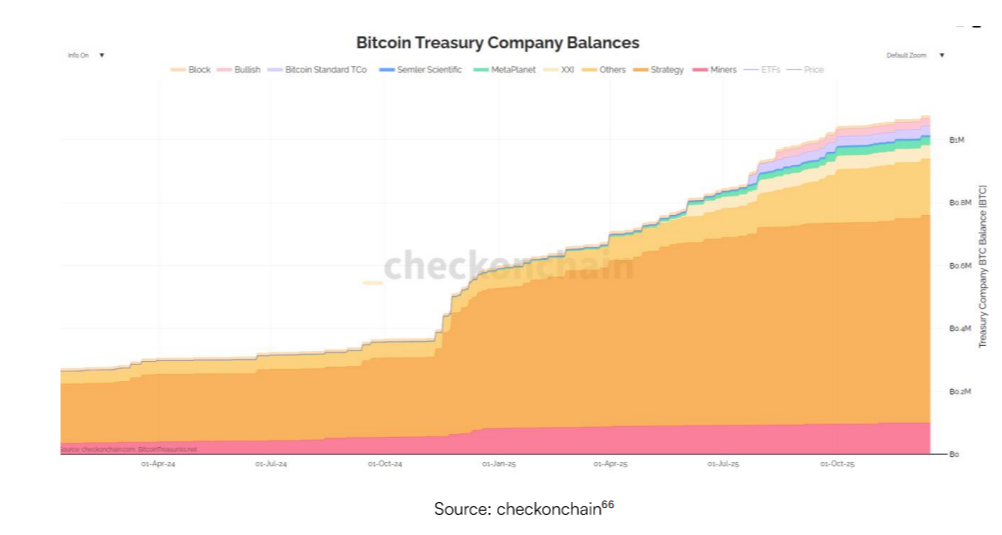
Bitcoin treasury companies have been hit hard by Bitcoin’s disappointing price action throughout 2025. Publicly traded firms holding significant BTC reserves are suffering the most, with leaders like (Micro)Strategy pushing aggressive accumulation amid headwinds—yet most now trade below net asset value, creating a rare opportunity for risk-tolerant strategic investors.

Tracking BTC holdings of the top public Bitcoin Treasury Companies.
Figure 1: Tracking BTC holdings of the top public Bitcoin Treasury Companies. View live chart.

The Bitcoin Treasury Companies Landscape

Not all Bitcoin treasury companies are created equally. Strategy stands apart as the industry standard-bearer, the “Bitcoin among treasury companies,” as it were. The company has maintained its accumulation discipline even as its stock has suffered, recently announcing a $1.44 billion USD reserve specifically designed to pay dividends and debt obligations without forcing Bitcoin sales.

This capital buffer theoretically eliminates the need for excessive dilutive share issuance or forced BTC liquidation, a critical distinction from weaker competitors. Many will likely face shareholder pressure and potential forced selling as their stock prices decline, creating a cascade of supply pressure that could paradoxically benefit the strongest players like MSTR.

Valuation Dynamics of Bitcoin Treasury Companies

The most compelling aspect of current treasury company valuations is that they now trade below net asset value on a per-share basis. In practical terms, you can currently purchase one dollar’s worth of Bitcoin for less than one dollar through treasury company stock. This represents an arbitrage opportunity for investors, though one accompanied by elevated volatility and company-specific risks.

Figure 2: Bitcoin Magazine Pro’s top 20 public Bitcoin Treasury Company HODLboard. View live table.

Strategy currently sits at a net asset value premium of less than 1, meaning the company’s market capitalization is below the value of its Bitcoin holdings alone. The upside scenario is striking. If Bitcoin reclaims its previous all-time high around $126,000, Strategy continues accumulating toward 700,000 BTC, and the market assigns even a modest 1.5x to 1.75x net asset value premium, Strategy could approach the $500 region per share.

From Weak to Strong: The Future of Bitcoin Treasury Companies

Examining Strategy’s performance during the previous Bitcoin bear market and overlaying it onto the current cycle reveals eerie alignment. The bar patterns suggest current price levels represent reasonable support, with only a catastrophic final flush justified by Bitcoin weakness providing reason to expect substantially lower levels.

As weaker treasury companies face forced selling, a consolidation thesis emerges, that Strategy and similar strong-positioned players will potentially accumulate cheap Bitcoin from distressed sellers, further concentrating holdings in the most disciplined accumulators. This dynamic mirrors Bitcoin’s own consolidation process, weaker hands sell, stronger hands accumulate, and the asset becomes more concentrated among conviction holders.

Conclusion: Opportunity in Bitcoin Treasury Companies

Bitcoin treasury companies have for the most part delivered disappointing returns in 2025, but this performance has created a window of exceptional opportunity for disciplined investors. At current valuations, Strategy is essentially selling one dollar of Bitcoin for approximately 90 cents, a discount that becomes even more attractive if Bitcoin experiences one final capitulation flush. The probability of this scenario combined with Strategy’s positioned upside creates asymmetric risk-reward worthy of small, carefully-sized positions within aggressive portfolios.


For deeper data, charts, and professional insights into bitcoin price trends, visit BitcoinMagazinePro.com. Subscribe to Bitcoin Magazine Pro on YouTube for more expert market insights and analysis!


Bitcoin Magazine Pro

Disclaimer: This article is for informational purposes only and should not be considered financial advice. Always do your own research before making any investment decisions.

This post Bitcoin Treasury Companies Are Undervalued first appeared on Bitcoin Magazine and is written by Matt Crosby.

Source: Bitcoin Magazine – Read More

Bitcoin Magazine

Trump Says He Will Consider A Pardon for Samourai Bitcoin Wallet Co-Founder

President Donald Trump said he’ll review the case of Keonne Rodriguez, co-founder of Samourai Wallet, as questions mount over the federal conviction of the Bitcoin privacy software developer. 

When asked about Rodriguez’s upcoming prison sentence, Trump said, “I’ve heard about it. I’ll look at it.”

“I don’t know anything about it,” President Trump said. “But we’ll take a look.” 

Rodriguez publicly acknowledged Trump’s sentiment, tweeting “Your continued noise is working. Thank you to everyone pushing @realDonaldTrump to pardon Bill and me. Let’s get this over the line. #pardonsamourai”

Rodriguez, along with co-founder William “Bill” Hill, was convicted of conspiracy to operate an unlicensed money transmitting business, a charge stemming from Samourai Wallet, a Bitcoin privacy tool that allowed users to mix coins and maintain financial anonymity without giving up custody of their funds.

Details of the Samourai Wallet case

The case, which began under the Biden administration and continued through the Trump Justice Department, culminated in Rodriguez receiving a five-year sentence and Hill four years, though Hill’s age and recent autism diagnosis led to a reduced sentence.

Critics of the prosecution argue the case represents a dangerous precedent for the cryptocurrency industry. The U.S. Department of Justice claimed that Samourai Wallet facilitated over $2 billion in unlawful transactions and laundered more than $100 million from criminal sources. However, only the “unlicensed money transmission” charge survived a high-profile trial, raising questions about the strength of the case. 

Samourai Wallet’s mixing services, Whirlpool and Ricochet, were designed to obscure the origin of criminal proceeds from activities including drug trafficking, darknet marketplaces, fraud, cybercrime, and murder-for-hire operations. 

Court documents reveal the developers actively encouraged criminal use, describing the service as “money laundering for bitcoin” and promoting its tools on darknet forums.

The Department of Justice framed the case as part of a broader crackdown on crypto mixing services. Rodriguez had requested a light sentence, but the court imposed the statutory five-year maximum.

Trump’s comments come amid his campaign promises to defend the right to self-custody and financial privacy. During the 2024 Bitcoin Conference in Nashville, he pledged to end what he described as the “anti-crypto crusade” of the prior administration.

A pardon for Rodriguez and Hill would signal a clear commitment to those promises, protecting developers from legal exposure for building tools that enhance privacy and security for everyday Americans.

With Rodriguez set to report to prison on December 18 and Hill already sentenced, the Trump administration faces a high-profile decision that could shape the future of financial privacy, software development, and cryptocurrency regulation in the United States.

This post Trump Says He Will Consider A Pardon for Samourai Bitcoin Wallet Co-Founder first appeared on Bitcoin Magazine and is written by Micah Zimmerman.

Source: Bitcoin Magazine – Read More

Bitcoin Magazine

Bitcoin Price Bleeds Below $89,000 After Grim Weekend 

Bitcoin price endured another grim weekend, bleeding from the low-$92,000 range on Thursday to weekend lows near $87,000 as thin liquidity and sell pressure weighed on risk appetite.

The move below $90,000 came during typically illiquid Sunday trading, amplifying downside volatility as traders positioned cautiously ahead of a dense slate of U.S. economic data and central bank events this week.

At the lows, the bitcoin price was down roughly 7% on the month, continuing a choppy consolidation that has defined price action since October’s all-time high, per Bitcoin Magazine Pro data.

Broader crypto markets showed little sign of strength. 

Major altcoins including Solana, XRP, Dogecoin and Cardano continued to slide, extending double-digit monthly losses and reinforcing bitcoin’s dominance near 57% of total crypto market capitalization. Volumes remained muted, reflecting a lack of conviction rather than outright capitulation.

Macro overhangs remain front and center. In the U.S., traders are bracing for employment data, inflation prints, PMI readings and Fed commentary that could reshape rate expectations. 

Globally, attention is turning to Japan, where the Bank of Japan is widely expected to raise rates later this week — an event that could pressure yen-funded carry trades that have helped support risk assets, including bitcoin, over the past year.

Technically, analysts are watching the mid-$80,000s closely. A sustained break below that zone could invite a deeper correction, while holding it would reinforce the idea that the bitcoin price remains range-bound rather than entering a new bear phase.

How low will the Bitcoin price go? 

Despite the uneasy backdrop, some of the loudest bearish calls are running far ahead of the data. Bloomberg Intelligence strategist Mike McGlone warned this week that the bitcoin price could collapse as much as 90% from its peak, potentially revisiting $10,000 in a future deflationary downturn. 

The forecast echoes prior bearish calls and comes as leveraged long positions continue to unwind, with roughly $230 million in bitcoin longs liquidated over the past 24 hours.

On-chain data, however, tells a far more nuanced story.

Bitcoin Magazine Pro’s Price Forecast Tools — built on network fundamentals rather than sentiment — suggest the market is trading below fair value, not on the brink of structural collapse. 

Aggregated indicators such as CVDD, Balanced Price and the Bitcoin Cycle Master currently point to a fair market value near $106,000, with long-term downside risk clustering closer to the $80,000 range rather than anywhere near five figures.

Historically, these metrics have aligned closely with cycle tops and bottoms, offering a framework that cuts through short-term noise. 

While macro conditions will continue to dictate volatility, on-chain signals suggest the current drawdown looks more like late-cycle consolidation than the start of a generational unwind.

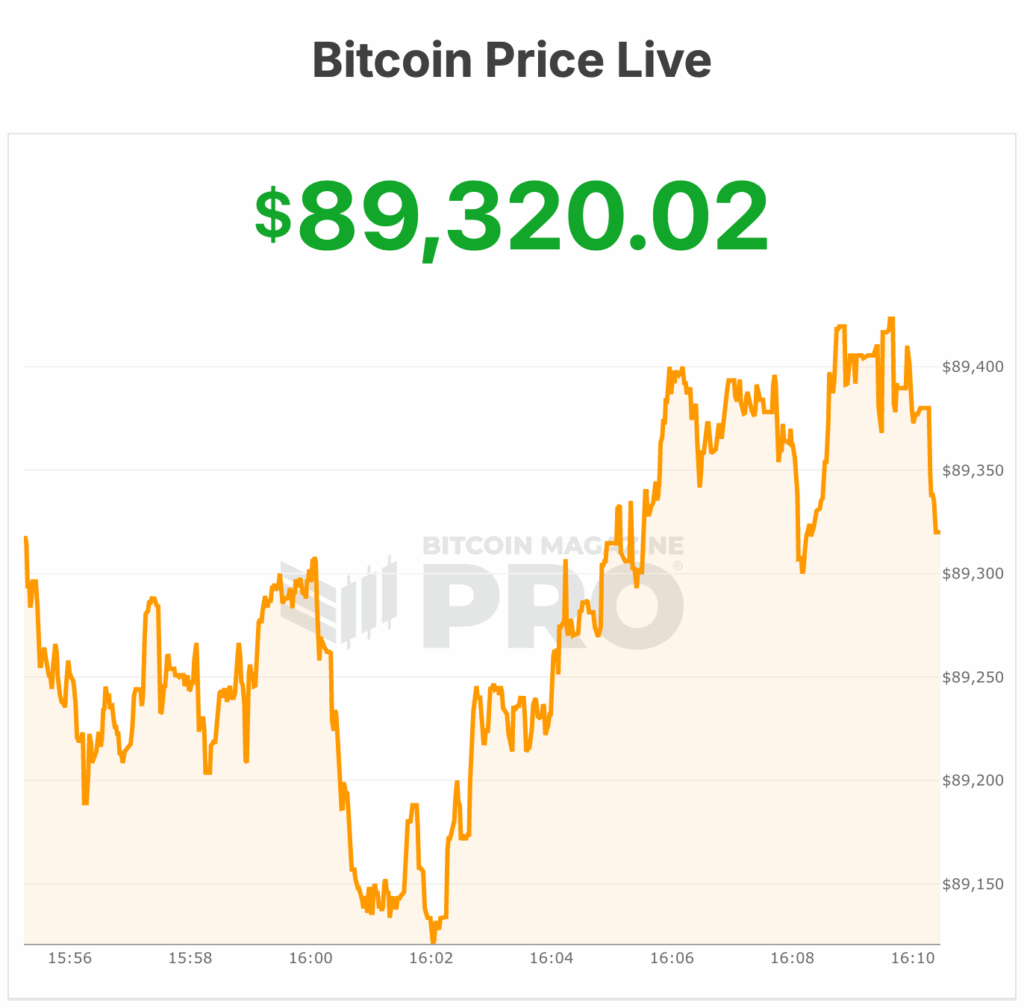
At the time of writing, the bitcoin price is $89,317.

Bitcoin price

This post Bitcoin Price Bleeds Below $89,000 After Grim Weekend  first appeared on Bitcoin Magazine and is written by Micah Zimmerman.

Source: Bitcoin Magazine – Read More

Bitcoin Magazine

Michael Saylor’s Strategy ($MSTR) Makes Second Straight $1 Billion Bitcoin Buy

Strategy, the world’s largest publicly traded bitcoin holder, added nearly another $1 billion worth of BTC last week, marking its second consecutive mega-purchase as bitcoin prices pulled back toward the $90,000 level.

The company acquired 10,645 bitcoin for approximately $980.3 million, paying an average price of $92,098 per BTC, according to a filing released Monday. 

Strategy now holds 671,268 bitcoin, purchased for a total of $50.33 billion, giving it an average acquisition cost of $74,972 per coin.

As with recent purchases, the acquisition was funded primarily through equity issuance. The company raised $888.2 million through sales of common stock, with the remainder coming from sales of its STRD preferred shares.

Despite ongoing concerns around shareholder dilution, the company has aggressively leaned on equity markets to increase its bitcoin exposure.

The latest buy comes amid a broader pullback in bitcoin, which dipped below $90,000 over the weekend before stabilizing near $89,600. MSTR shares were flat in premarket trading Monday.

The purchase stands out not only for its size, but for its timing. While Strategy has been a steady buyer throughout 2025, most of its weekly acquisitions in recent months were relatively modest due to fundraising constraints. 

Over the past two weeks, however, Executive Chairman Michael Saylor has ramped up purchases, signaling renewed conviction despite volatility in both bitcoin and Strategy’s stock.

Strategy ($MSTR) stays on the Nasdaq 100

Separately, MSTR confirmed it will remain a constituent of the Nasdaq 100, maintaining its position in the index under the technology category. 

The company has also pushed back against proposals from index provider MSCI, which is reviewing whether to exclude bitcoin treasury companies from its benchmarks.

In the letter, Strategy argued that their proposed digital asset threshold is “misguided” and would have “profoundly harmful consequences.”

MSCI is expected to make a final decision in January.

The company, formerly known as MicroStrategy, pivoted from enterprise software to a bitcoin-focused treasury strategy in 2020. The model has since been replicated by dozens of firms, though critics argue these companies increasingly resemble bitcoin investment vehicles rather than operating businesses.

Still, Saylor has remains unapologetic and bold in his purchasing decisions. As of December 14, 2025, Strategy reports a year-to-date BTC yield of 24.9%, showing its commitment to accumulating bitcoin regardless of short-term market or equity price pressures.

At the time of writing, bitcoin is trading near $89,650. 

Strategy

This post Michael Saylor’s Strategy ($MSTR) Makes Second Straight $1 Billion Bitcoin Buy first appeared on Bitcoin Magazine and is written by Micah Zimmerman.

Source: Bitcoin Magazine – Read More

Bitcoin Magazine

Coinbase is About to Launch Prediction Markets and Tokenized Stocks: Report

Coinbase is reportedly preparing to launch its own prediction markets, powered by U.S.-based operator Kalshi, in a move that could expand the types of assets available on the exchange amid cooling investor interest in cryptocurrencies, according to reporting from Bloomberg and CNBC.

The announcement is expected to come next week, coinciding with Coinbase’s “Coinbase System Update” showcase on Dec. 17. While the exchange declined to confirm specifics, it encouraged users to tune into the livestream for updates.

Rumors of the new prediction markets have been circulating for nearly a month. In mid-November, tech researcher Jane Manchun Wong shared a screenshot of what appeared to be Coinbase’s prediction markets dashboard. 

The Information first reported the planned launch on Nov. 19, and Bloomberg later cited a source saying the event would also feature the rollout of tokenized stocks.

Coinbase as an ‘everything’ exchange

Coinbase’s moves align with CEO Brian Armstrong’s long-stated vision of building an “everything exchange” — a single platform offering access to crypto tokens, tokenized equities, and event-based contracts. 

Armstrong told investors in May that Coinbase aims to become a leading financial services app within the next decade.

The exchange is accelerating these initiatives amid rising competition from firms such as Robinhood, Gemini, and Kraken

Over the past year, these platforms have expanded tokenized stock offerings outside the U.S. and explored prediction markets, reflecting growing demand for alternative trading instruments.

The timing also comes as investor sentiment toward digital assets has cooled. A wave of liquidations in highly leveraged positions in mid-October triggered a crypto market pullback, prompting some investors to shift capital into safer assets. 

For Kalshi, the partnership marks another step in its strategy to integrate event contracts into mainstream trading platforms. 

Earlier this year, the company embedded its prediction markets into Robinhood, and it is reportedly in discussions with other brokers, including those in crypto, to expand its reach.

Prediction markets let users speculate on outcomes ranging from elections to sports games, and they have grown increasingly popular over the past year. Traditional exchanges and crypto platforms alike are now exploring them as a new way to engage traders. 

Gemini recently received approval to roll out its own prediction markets, while Crypto.com has partnered with the Trump Media & Technology Group on similar initiatives.

Coinbase’s planned in-house tokenized stock offerings would put it on par with competitors like Robinhood and Kraken, which currently offer similar products outside the U.S.

This post Coinbase is About to Launch Prediction Markets and Tokenized Stocks: Report first appeared on Bitcoin Magazine and is written by Micah Zimmerman.

Source: Bitcoin Magazine – Read More

Bitcoin Magazine

Bitcoin Falls Below $90,000 As Vanguard Exec Struggles With Bitcoin Value 

The bitcoin price was trading in the $92,000 range earlier today but has now dropped back toward $90,000, reflecting continued volatility despite the U.S. Federal Reserve’s 25-basis-point rate cut. 

After briefly spiking above $93,000 yesterday, the crypto fell below $90,000 and stabilized around $90,600 at the time of writing.

The pullback comes amid mixed signals from the Fed. While the rate cut to 3.50%–3.75% was widely anticipated, Fed Chair Jerome Powell’s cautious remarks and a 9–3 split among FOMC members — one favoring a deeper 50-basis-point cut and two opposing any reduction — tempered enthusiasm for risk assets, including BTC.

Analysts described the decline as a “sell the fact” reaction, since markets had already priced in the move.

On top of this, Vanguard Group has begun allowing clients to trade spot Bitcoin exchange-traded funds (ETFs), marking a notable expansion in access to crypto products for the $12 trillion asset manager’s investors. 

Yet, Vanguard’s senior leadership emphasized that its fundamental view of BTC and other cryptocurrencies remains skeptical.

John Ameriks, Vanguard’s global head of quantitative equity, said Thursday at Bloomberg’s ETFs in Depth conference that Bitcoin is better seen as a speculative collectible than a productive asset. 

Comparing it to a viral plush toy, Ameriks highlighted that BTC lacks income, compounding potential, and cash-flow generation — the core attributes Vanguard looks for in long-term investments. 

“Absent clear evidence that the underlying technology delivers durable economic value, it’s difficult for me to think about Bitcoin as anything more than a digital Labubu,” he said, according to Bloomberg.

Despite this caution, Vanguard’s decision to allow trading of BTC ETFs on its platform was influenced by the growing track record of such products since the first BTC ETF launched in January 2024. 

Ameriks said the firm wanted to ensure these ETFs accurately reflect their advertised holdings and perform as expected.

Banks engaging with bitcoin

Earlier this week, PNC Bank became the first major U.S. bank to offer direct spot bitcoin trading to eligible Private Bank clients through its digital platform, using Coinbase’s Crypto-as-a-Service infrastructure. 

The launch follows a strategic partnership announced in July and reflects a growing trend among U.S. banks to integrate bitcoin into wealth management services.

Also last week, the Bank of America urged its wealth management clients to allocate 1% to 4% of their portfolios to digital assets, signaling a major shift in its approach to Bitcoin exposure. 

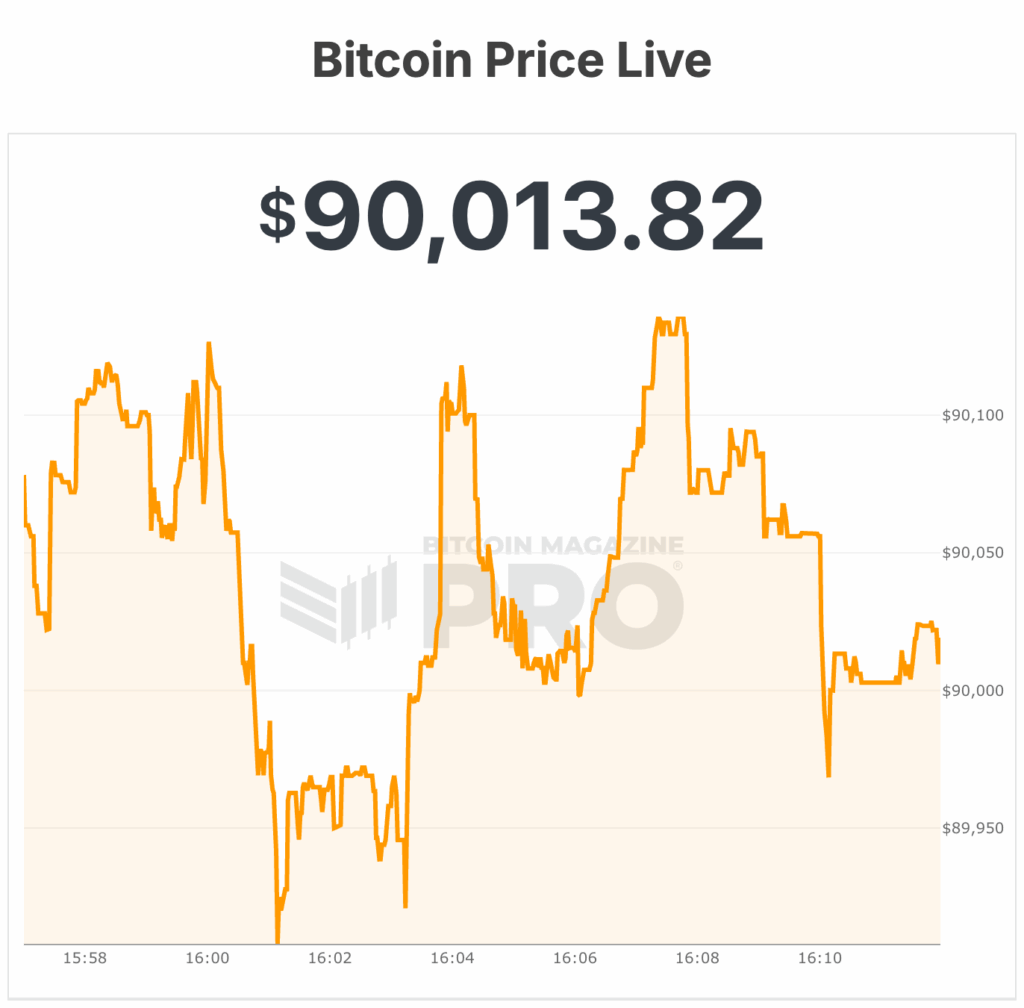
As of today, Bitcoin is trading at approximately $90,115.85, with a circulating supply of nearly 19.96 million BTC and a market cap of $1.81 trillion. 

Prices have fluctuated modestly over the past week, reflecting the broader market’s volatility.

bitcoin

This post Bitcoin Falls Below $90,000 As Vanguard Exec Struggles With Bitcoin Value  first appeared on Bitcoin Magazine and is written by Micah Zimmerman.

Source: Bitcoin Magazine – Read More

Bitcoin Magazine

Five Crypto Firms Win Conditional Approvals as National Trust Banks, Including Fidelity and BitGo

The U.S. Office of the Comptroller of the Currency (OCC) has granted conditional approvals for five digital asset firms — Ripple, Circle, Fidelity Digital Assets, BitGo, and Paxos — to become federally chartered national trust banks, marking a major milestone in the integration of cryptocurrency into traditional finance.

The approvals, announced Friday, allow the firms to convert from state-level trust charters to federal status, subject to meeting the OCC’s conditions. 

Once finalized, these institutions will join roughly 60 other national trust banks regulated by the OCC, gaining the ability to offer fiduciary and custody services nationwide. 

Unlike larger national banks, trust banks cannot accept cash deposits or make loans, but they can hold and manage customers’ digital assets.

‘Huge news’ for crypto

Circle, issuer of the $78 billion USDC stablecoin, said the charter would enhance the safety and regulatory oversight of its reserves while enabling fiduciary digital asset custody for institutional clients.

CEO Jeremy Allaire emphasized that the federal charter would provide “greater clarity and confidence” to institutions building on Circle’s platform as stablecoins gain mainstream adoption.

Paxos, known for PYUSD and the consortium-backed Global Dollar (USDG), said federal oversight would allow businesses to issue, custody, trade, and settle digital assets with clarity and confidence. 

The firm, which has operated under a New York Department of Financial Services (NYDFS) charter since 2015, first applied for a federal charter in 2020.

BitGo, a South Dakota–based crypto custodian, said the federal charter would allow it to expand services nationwide, including trading, staking, stablecoin, and treasury offerings for institutions. BitGo has also filed to go public, reporting $4.19 billion in revenue for the first half of 2025, up from $1.12 billion during the same period in 2024.

The approvals reflect a broader trend toward federal oversight of digital assets, coming after Anchorage Digital became the first federally chartered crypto bank in the U.S. Other firms, including Coinbase, Bridge (owned by Stripe), and Crypto.com, have also applied for federal charters.

OCC Comptroller Jonathan V. Gould emphasized that new entrants into the federal banking sector benefit consumers, foster competition, and promote innovation.

 “The OCC will continue to provide a path for both traditional and innovative approaches to financial services to ensure the federal banking system keeps pace with the evolution of finance and supports a modern economy,” Gould said.

This post Five Crypto Firms Win Conditional Approvals as National Trust Banks, Including Fidelity and BitGo first appeared on Bitcoin Magazine and is written by Micah Zimmerman.

Source: Bitcoin Magazine – Read More

Bitcoin Magazine

Bitcoin Price Forecast Tools and Cycle Valuation Metrics

The Bitcoin Magazine Pro Price Forecast Tools chart provides a comprehensive framework for identifying potential price floors during bear cycles and forecasting upside targets based on on-chain fundamentals and network-derived data points. By aggregating multiple metrics, this methodology has historically called Bitcoin market cycle peaks and bottoms with remarkable accuracy. Can these tools continue to provide a basis for reliable BTC price forecasting over the next 12 months and beyond?

CVDD & Balanced Price: Bitcoin Price Cycle Low Indicators

The Cumulative Value Days Destroyed (CVDD) metric has historically called Bitcoin price cycle lows almost to perfection across every cycle since Bitcoin’s inception. This metric begins with Coin Days Destroyed, a measure that weights Bitcoin transfers by the duration they were held before movement. For example, holding 1 Bitcoin for 100 days produces 100 coin days destroyed when transferred, while holding 0.1 Bitcoin for the same result requires 1,000 days of holding. Large spikes indicate that the network’s most experienced long-term holders are transferring significant amounts of Bitcoin.

Figure 1: The convergence of the CVDD and Balanced Price with BTC price has historically aligned with bear market lows. View Live Chart

The CVDD takes this one step further by measuring the USD valuation at the time of transfer rather than just the coin days destroyed quantity alone. This value is then multiplied by 6 million to produce the final metric. When examined across Bitcoin’s entire history, the CVDD has indicated bear market lows with accuracy extending across every cycle. Currently, the CVDD sits at approximately $45,000, though this level trends upward over time as the metric naturally evolves with new transfers and Bitcoin’s price appreciation.

The Balanced Price metric complements this downside projection by subtracting the Transferred Price (its calculation methodology is explained later) from the Realized Price, the cost basis or average accumulation price for all bitcoin holders, providing another historically accurate bear cycle low signal. 

Top Cap, Delta Top, & Terminal Price: Bitcoin Price Cycle Peak Signals

The Top Cap metric begins with the all-time average cap, the cumulative sum of Bitcoin’s market capitalisation divided by the number of days Bitcoin has existed. This all-time weighted moving average is then multiplied by 35 to produce the Top Cap. Historically, this metric has been remarkably accurate for calling bull market peaks, though in recent cycles it has exceeded actual price action, currently projecting to a seemingly unattainable ~$620,000.

The Delta Top refines this approach by using the realized cap. The realized cap currently stands at approximately $1.1 trillion. Delta Top is calculated by subtracting the average cap from the realized cap and multiplying by 7. This metric has been accurate historically, though it was slightly off during the 2021 cycle, and it is looking more likely that it will not be reached in the current cycle, currently sitting at approximately $270,000.

Figure 2: Delta Top and Terminal Price metrics have frequently aligned with market tops. View Live Chart

The Terminal Price metric provides another layer of sophistication. It calculates the Transferred Price, the sum of Coin Days Destroyed divided by the Circulating Bitcoin Supply, and multiplies this by 21 (the maximum Bitcoin supply). This produces a price level based on the fundamental assumption of total network value distributed across all 21 million Bitcoins. Historically, the Terminal Price has been one of the most accurate top-calling tools, marking previous cycle peaks nearly to perfection. This metric currently sits at approximately $290,000, not too far above Delta Top’s current value.

Bitcoin Cycle Master: Aggregated Bitcoin Price Fair Value Framework

Integrating all these individual metrics into a unified framework produces the Bitcoin Cycle Master chart, which combines these on-chain forecast tools for confluence. This has helped to identify where Bitcoin may be in a cycle, either close to bull or bear market highs, or oscillating around its ‘Fair Market Value’.

Figure 3: The Bitcoin Cycle Master currently indicates a Fair Market Value of approximately $106,000. View Live Chart

Examining the past two cycles demonstrates the utility of this framework. When Bitcoin trades above the Fair Market Value band, bull markets have historically entered exponential growth phases. When beneath this band, Bitcoin typically signals bear market conditions where defensive positioning and aggressive accumulation become appropriate strategies. 

Projecting Bitcoin Price Forward: 2026 Cycle Scenarios

By extracting raw data from the price forecast tools and projecting the slope of both the CVDD and Terminal Price forward to the end of 2026, two scenarios emerge. The CVDD, which has moved at a predictable rate of change over the past 90 days, projects to approximately $80,000 by December 31, 2026. This level could represent a potential bear cycle floor, though Bitcoin has already traded beneath this level during recent downward moves, suggesting current prices may already offer compelling value.

Figure 4: Extrapolating the CVDD and Terminal Price metrics across 2026 provides a considerable range for potential BTC price action.

The Terminal Price, extrapolating its current upward trend, could reach over $500,000 by the end of 2026, though this projection could only be a realistic outcome with a bullish macro environment with significant liquidity injections and broad realization of Bitcoin’s fundamental value proposition. 

Conclusion: What Bitcoin Price Forecast Tools Are Signaling for 2025–2026

These Bitcoin price forecast tools, formulated using on-chain fundamental and network-derived data points rather than psychological levels or traditional technical analysis applicable to equities and commodities, have historically provided exceptional accuracy in calling market cycle peaks and bottoms. Forecasting based on their current values suggests a potential bear cycle floor in the $80,000 range by the end of 2026, with upside targets potentially reaching over $500,000, depending on macro conditions and capital flows. 

While these projections represent extrapolations of current trends rather than certainties, the historical accuracy and on-chain foundation of these metrics warrant serious consideration. Investors and traders should continue monitoring both the raw price forecast tools and the aggregated Bitcoin Cycle Master framework to identify fair valuation levels, extreme overvaluation warnings, and attractive accumulation zones within the current cycle. However, all projections change daily as new data emerges, making reactive analysis superior to long-term prediction.

For a more in-depth look into this topic, watch our most recent YouTube video here: Bitcoin: Using On-Chain Data To Value & Predict The Price


For deeper data, charts, and professional insights into bitcoin price trends, visit BitcoinMagazinePro.com. Subscribe to Bitcoin Magazine Pro on YouTube for more expert market insights and analysis!


Bitcoin Magazine Pro

Disclaimer: This article is for informational purposes only and should not be considered financial advice. Always do your own research before making any investment decisions.

This post Bitcoin Price Forecast Tools and Cycle Valuation Metrics first appeared on Bitcoin Magazine and is written by Matt Crosby.

Source: Bitcoin Magazine – Read More

Bitcoin Magazine

9 Ways MSCI’s Proposed Digital Asset Rule Could Undermine Index Neutrality

A major rule change is being considered by MSCI, one of the most influential index providers in global markets. If adopted, it would materially alter how public companies that hold digital assets—particularly Bitcoin—are classified and included in major equity indexes.

For companies, investors, asset managers, and anyone who depends on index-based benchmarks, this proposal raises fundamental questions about how markets define operating businesses and what role balance sheets should play in index eligibility.

Join the call for MSCI to withdraw its digital asset exclusion rule.

Here’s what’s at stake—and why it matters.

1. MSCI Is Proposing a New 50% Balance-Sheet Threshold

At the center of the proposal is a simple rule:

If digital assets make up 50% or more of a company’s total assets, that company would be excluded from MSCI’s Global Investable Market Indexes.

MSCI’s rationale is that crossing this threshold allegedly changes the company’s “primary business,” making it more fund-like rather than operational.

This single ratio would override all other indicators of what the company actually does.

2. The Proposal Misclassifies Operating Companies as Investment Funds

The core objection is straightforward:
holding Bitcoin on a balance sheet does not transform an operating company into an investment fund.

  • Operating companies generate revenue from products and services
  • They employ people, invest in R&D, and serve customers
  • Treasury assets exist to support long-term capital strategy

By contrast, investment funds exist solely to manage portfolios for return.

Treating these two structures as equivalent—based on a balance-sheet ratio alone—collapses a distinction that has long been foundational to corporate and securities law.

If your organization relies on clear, fundamentals-based definitions of operating companies, this misclassification matters. Bitcoin For Corporations is asking MSCI to withdraw the proposal and engage on a more principled framework. You can add your name to the open letter here.

3. Treasury Strategy Does Not Redefine Core Business Activity

A company can change how it stores excess capital without changing what it does.

  • A manufacturer that holds cash remains a manufacturer
  • A software firm holding foreign currency remains a software firm
  • A company holding Bitcoin as treasury reserve remains an operating company

Treasury allocation is a capital management decision, not a change in business model.

4. This Would Be a Radical Departure From Decades of Index Practice

Historically, index classification has been driven by operational reality, not asset composition alone.

Primary business determination has relied on:

  • Revenue sources
  • Earnings contribution
  • Ongoing commercial activity

This proposal replaces that holistic approach with a single market-price-driven metric on the asset side of the balance sheet—something never applied consistently across asset classes before.

5. Digital Assets Are Being Singled Out—Uniquely

Under the proposal:

  • A company with 51% of assets in Bitcoin → excluded
  • A company with 51% in real estate → included
  • A company with 51% in equities or commodities → included

No equivalent rule exists for other treasury assets.

This lack of neutrality directly conflicts with the principles that global indexes are supposed to uphold.

6. The Proposal Conflicts With Core Index Principles

MSCI’s benchmarks are built on three foundational ideas:

  • Neutrality – no asset-class favoritism
  • Representativeness – reflecting real economic activity
  • Stability – avoiding unnecessary churn

A rule that reclassifies companies based on volatile market prices undermines all three.

7. The Rule Would Introduce Structural Instability Into Indexes

Consider a company with:

  • 45% of assets in digital form → eligible
  • No operational change
  • Normal market appreciation pushes it to 51%

Under the proposal, that company would suddenly be excluded—despite:

  • No change in revenue
  • No change in operations
  • No change in business strategy

This creates a scenario where companies could flip in and out of indexes purely due to price movement, forcing unnecessary rebalancing, costs, and tracking error for index-linked funds.

This kind of mechanical instability would impose real costs on index-tracking funds, issuers, and long-term investors—without improving market clarity. That’s why companies and market participants are urging MSCI to withdraw the proposal and revisit it with industry input. Join the call for MSCI to withdraw this rule proposal, and add your signature to the open letter here.

8. A More Robust Alternative Already Exists

The issue is not classification—it’s how classification is done.

A principles-based, multi-factor framework would evaluate:

  • Revenue and earnings mix
  • Legal and regulatory status
  • Core corporate activities (employees, R&D, capex)
  • Public disclosures and stated strategy

This approach reflects the entire business, not a single fluctuating ratio.

9. The Coalition’s Ask Is Clear and Constructive

Market participants are calling for a two-step solution:

  1. Withdraw the current proposal due to its structural flaws
  2. Engage with the market to develop a neutral, principles-based framework that preserves index integrity

The goal is not special treatment—but consistent treatment aligned with long-standing market norms.

Why This Matters

Indexes are not academic exercises. They:

  • Guide trillions of dollars in capital allocation
  • Shape passive investment flows
  • Influence cost of capital for public companies

If index rules become arbitrary, unstable, or asset-specific, they stop reflecting the real economy—and start distorting it.

Final Thought

If your organization depends on fundamentals-based equity benchmarks, this proposal affects you—whether or not you hold digital assets today.

Indexes only work when they remain neutral, stable, and grounded in operating reality. Market participants are asking MSCI to withdraw the proposed digital asset rule and work toward a principles-based alternative.If you or your organization depend on fair and consistent equity benchmarks, adding your signature to the open letter helps ensure those standards are preserved.

Index integrity relies on clear principles, not price-driven thresholds.

Engagement now helps ensure global benchmarks remain neutral, stable, and representative for everyone who relies on them.

Disclaimer: This content was prepared on behalf of Bitcoin For Corporations for informational purposes only. It reflects the author’s own analysis and opinion and should not be relied upon as investment advice. Nothing in this article constitutes an offer, invitation, or solicitation to purchase, sell, or subscribe for any security or financial product.

This post 9 Ways MSCI’s Proposed Digital Asset Rule Could Undermine Index Neutrality first appeared on Bitcoin Magazine and is written by Nick Ward.

Source: Bitcoin Magazine – Read More

Bitcoin Magazine

What is a Bitcoin Treasury Company?

Bitcoin is no longer just a grassroots monetary revolution. It’s in the process of moving from the periphery of finance into its centre. The rise of Bitcoin treasury companies is a major force behind this shift. These are firms that accumulate bitcoin not as a side bet, but as a core balance sheet holding. In doing so, they provide access to capital markets, offer yield-bearing instruments, and reshape how companies think about monetary preservation.

This article explores what Bitcoin treasury companies are, how they operate, and why their emergence matters, for both corporate finance and Bitcoin’s long-term trajectory.

Key Takeaways

  • Bitcoin treasury companies hold bitcoin as a long-term treasury reserve, often replacing fiat cash or short-term bonds.
  • These companies expand bitcoin’s investable capital base by enabling access through public equity or corporate debt.
  • Public treasury firms may trade at a premium to their bitcoin holdings due to market access, regulatory arbitrage, and capital efficiency.
  • Some companies issue bitcoin-backed financial products such as yield notes or strategic reserves.

What is a Treasury Company?

A Bitcoin treasury company business model, whereby a business integrates bitcoin into its treasury management framework. This approach prioritizes monetary certainty over fiat liquidity. The company treats bitcoin as a base-layer reserve asset superior to sovereign currency, rather than a hedge or speculative position.

Treasury companies may be public or private. Public companies often use their regulatory status to issue stock or debt, which is then converted into bitcoin. Private firms generally rely on retained earnings. Regardless of structure, the key factor is that bitcoin becomes the foundation of the corporate treasury, not a side asset.

These companies use bitcoin to manage long-term purchasing power, defend against monetary debasement, and unlock investor access in regions or structures where direct exposure is restricted. The treasury strategy shapes their business identity and capital allocation, often attracting shareholders who value monetary independence.

For a deeper look at the three operating models—pure play, hybrid operator, and strategic holder—see this breakdown from Michael Saylor.

What Purpose Does It Serve?

Bitcoin treasury companies restructure their balance sheets to reflect a predictable monetary strategy championing absolute scarcity over fiat stability. Holding bitcoin allows them to escape the inflationary decay of sovereign currency while signaling long-term capital discipline.

The strategy serves two core purposes: 

  1. it defends shareholder value by shifting reserves into a scarce, non-counterparty asset.
  2. it creates financial access for investors who cannot hold bitcoin directly. Through their equity or debt instruments, treasury companies channel restricted capital into the Bitcoin ecosystem.

These firms also develop financial products around their holdings. Bitcoin-backed notes, interest-bearing instruments, and convertible structures create yield opportunities. In these cases, the treasury company acts as a financial services platform as well as a capital allocator.

Expanding Bitcoin’s Capital Base

Bitcoin treasury companies serve as access points to the asset for capital that would otherwise remain on the sidelines. As Steven Lubka put it, they are “fundamentally expanding the amount of capital that can flow into bitcoin… They are not competing for the same pool of dollars; they are making the pool larger.”

Most institutional allocators are still trapped inside structures that prohibit direct bitcoin exposure. Their mandates require them to hold equities, bonds, or fund shares—not bearer assets. Treasury companies bypass that restriction. By holding bitcoin and offering tradable equity or fixed income products, they act as financial bridges that translate bitcoin exposure into forms institutions can legally hold.

This approach allows adoption to scale without waiting for regulatory charters or compliance approval. This is infrastructure that routes around the choke points.

Mechanics: How It Works

While each company operates within its own legal, regulatory, and financial constraints, most follow a similar operational structure. The details may vary, but the following components form the backbone of how they operate.

  1. Acquisition –  The company acquires bitcoin using excess cash or proceeds from capital raises. This is typically done through over-the-counter (OTC) trading desks or institutional-grade exchanges. Some firms that operate in the mining space may allocate mined bitcoin directly to treasury, removing market exposure altogether.
  2. Custody –  Firms must decide between self-custody and third-party custodians. Institutional custodians like Fidelity Digital Assets, Anchorage, or Coinbase Custody offer compliance and insurance options, while self-custody provides sovereignty at the cost of internal security complexity. Custody decisions affect not just risk, but also regulatory posture.
  3. Accounting –  Under current US GAAP rules, bitcoin is classified as an intangible asset. Impairments are recognized if market value drops below the acquisition cost, but gains are not recorded unless realized through a sale. This creates an asymmetric treatment that can distort quarterly earnings and force conservative reporting, even if treasury value increases.
  4. Reporting –  Public treasury companies are required to disclose bitcoin holdings and changes in treasury structure through filings, earnings reports, and shareholder updates. Some choose to go further, publishing regular updates or dedicating resources to explaining their bitcoin strategy in detail.
  5. Security –  Private key management is without question, a critical part of the operation. Companies typically use multisignature wallets, geographic key separation, cold storage, and internal controls to secure holdings. Firms with large positions may employ Shamir’s Secret Sharing or multiple independent signers to ensure redundancy and resilience.
  6. Governance –  Policies must define how bitcoin is acquired, secured, and reported. This includes buy thresholds, custody control frameworks, access rights, key management protocols, and recovery plans. Strong governance ensures the strategy survives beyond the initial executive vision and becomes embedded in company operations.

Read More: 9 Ways Bitcoin Treasury Companies Can Differentiate in a Crowded Market.
Read More: The Global Bitcoin Treasury Playbook 

How Are They Even Possible?

Bitcoin treasury companies operate within a regulatory environment where public firms enjoy broader access to capital markets than individuals or funds. This creates a structural advantage. A public company can issue equity or debt, raise fiat capital efficiently, and convert it to bitcoin. In contrast, many institutional investors face custodial, legal, or charter-based constraints that prevent them from holding bitcoin directly.

This dynamic creates a form of regulatory arbitrage. The company acts as a wrapper for bitcoin exposure, allowing capital to enter the market through familiar financial instruments like stocks and bonds. Investors gain indirect access to bitcoin, often through vehicles they are already authorized to hold.

This mechanism is similar to financial innovations of the past. In the 1980s, Salomon Brothers restructured the bond market by slicing and repackaging fixed-income assets to match investor demand. Other sectors used wrappers to route capital around institutional constraints. Bitcoin treasury companies apply the same principle: they turn capital markets into a funnel and aim it at a harder monetary asset.

Regulatory Arbitrage: Why These Companies Even Exist

Bitcoin treasury companies operate in a unique zone of regulatory asymmetry. As Lubka notes on p39, of issue 39 of Bitcoin Magazine, “What bitcoin treasury companies are doing is engaging in regulatory arbitrage.”

Public companies can access large pools of capital through stock and debt issuance. They can then deploy that capital into bitcoin. Retail investors, pension funds, and even many hedge funds cannot hold bitcoin directly—but they can buy shares in public companies.

This is not a technicality. It’s a structural end-run around the gatekeepers of capital. While a retirement fund can’t buy spot bitcoin, it can buy shares in a firm like MicroStrategy. That dynamic turns treasury companies into Trojan horses—pulling bitcoin exposure into portfolios that would otherwise be prohibited from touching it.

Background and Origins

The treasury model gained serious traction in August 2020, when MicroStrategy ($MSTR) allocated $250 million of its reserves to bitcoin. CEO Michael Saylor framed the move as a rational response to fiat debasement and falling real yields. The firm continued raising capital through debt and equity issuance to expand its position, ultimately acquiring over 650,000 BTC.

Other public companies followed. Tahini’s began stacking bitcoin a mere days after MicroStrategy. Tesla ($TSLA) added $1.5 billion in bitcoin to its treasury in early 2021. Square ($SQ), now Block, also made an allocation, citing long-term purchasing power as the key motivation. These high-profile moves signaled that bitcoin was gaining legitimacy as a treasury reserve among large-cap firms.

To support institutional adoption, MicroStrategy, in partnership with BTC Inc launched Bitcoin for Corporations, an annual event aimed at guiding CFOs, legal teams, and boards through the process of integrating bitcoin into treasury strategy. The event helped normalize bitcoin discussions inside traditional corporate structures.

A major barrier to adoption—accounting treatment—began to shift in 2023. The FASB approved new rules allowing companies to report bitcoin holdings at fair market value. This replaced the outdated impairment model and removed one of the most cited objections among public company CFOs. The change went into effect in 2025.

Read more: The Origin Story of Bitcoin Treasury Companies

Examples of Bitcoin Treasury Companies

MicroStrategy ($MSTR) is the most established treasury company in the market. It has redefined its corporate identity around bitcoin accumulation and capital efficiency. The company has raised billions through convertible notes and direct equity issuance, with proceeds allocated to bitcoin. Shareholders now view the firm as a long-term access vehicle to bitcoin’s monetary appreciation.

MetaPlanet ($3350.T) is a Japanese firm that executes a similar game plan to Strategy. Operating within Japan’s distinct regulatory environment, it adapts the treasury playbook to fit regional constraints. MetaPlanet illustrates how treasury adoption can be localized without losing strategic focus.

Smarter Web Company ($MCP), based in the UAE, blends infrastructure development with bitcoin accumulation. Its jurisdiction allows more flexibility in treasury construction, enabling a hybrid model that integrates operational revenue with bitcoin reserves.

Nakamoto Holdings ($NAKA), a subsidiary of KindlyMD, has built a vertically integrated treasury strategy that includes internal capital management and structured products. The firm was profiled by Steven Lubka as an example of how smaller organizations can implement bitcoin treasury models with institutional rigor.

Evaluating a Treasury Company and Measuring Success

The success of a bitcoin treasury company depends on more than just the size of its holdings. Investors should evaluate how efficiently the company acquires bitcoin, whether it increases bitcoin per share over time, and how effectively it monetizes its position.

A key metric is mNAV, or multiple of net asset value. This measures the company’s market capitalization relative to its bitcoin holdings. A high mNAV suggests that the market values not just the bitcoin, but also the company’s capital efficiency, access, and ability to grow its holdings faster than the open market.

Companies that compound bitcoin holdings through accretive financing deserve to trade at a premium. This premium reflects future expectations of value creation. However, poorly managed firms can destroy per-share bitcoin by issuing too much equity or overpaying for marginal gains.

Evaluating treasury companies requires examining their capital structure, acquisition timing, product issuance, and accounting treatment.

More info: How To Measure The Success Of A Bitcoin Treasury Company

Risks and Structural Headwinds

Bitcoin treasury companies operate within a set of structural risks that are distinct from simple asset volatility. These risks are operational, regulatory, reputational and political. There’s also a fifth opposing risk, which is the risk of not holding or having exposure to bitcoin at all.

  1. Operational Risk

Managing a bitcoin treasury introduces technical and procedural risks. Custody is not a service you can outsource without trust tradeoffs, and self-custody requires enterprise-grade key management practices. Multisignature configurations, geographic key separation, internal access controls, and incident recovery protocols must be implemented with precision. Any compromise in key security, whether from internal error or external attack, can result in unrecoverable losses. For companies holding hundreds of millions or billions in bitcoin, this becomes a single point of existential failure.

  1. Regulatory Risk

Bitcoin exists outside the traditional financial system, and many jurisdictions still lack a clear legal framework for its treatment. Treasury companies must navigate unclear tax rules, evolving securities classifications, cross-border restrictions, and ambiguous corporate governance expectations. Regulatory risk is amplified for public companies, which face additional scrutiny from auditors, exchanges, and shareholders. In many regions, bitcoin remains classified as a speculative asset, limiting how it can be reported or deployed within treasury operations.

  1. Reputational Risk

Corporate media, ESG pressure groups, and risk-averse investors typically view bitcoin adoption as speculative or irresponsible, especially during periods of price drawdown. Even competent treasury execution can be framed as reckless if narrative conditions turn. Leadership teams must be prepared to defend the strategy publicly and educate stakeholders who may not yet grasp the long-term monetary thesis.

  1. Political Risk

One of the most insidious risks facing treasury companies is the growing institutional pushback from legacy finance. In 2025, MSCI, BlackRock, and Goldman Sachs’ Datonomy index excluded MicroStrategy and Coinbase from digital asset classifications, despite bitcoin representing a majority of their balance sheet exposure. 

These companies were strategically removed because their alignment with bitcoin poses a structural threat to the existing banking order. Their inclusion in major indexes would legitimize bitcoin as a competing monetary system and weaken the financial establishment’s control over capital allocation.

This index engineering reduces investor access and protects legacy institutions. It is designed to suppress entities that store capital in an asset that cannot be debased, seized, or rehypothecated.

  1. Monetary Risk of Not Holding Bitcoin

A more widespread risk facing corporate treasuries is the cost of continuing to rely on fiat-based strategies. Inflation erodes capital over time by reducing purchasing power. Treasury strategies that depend on short-term government bonds or bank deposits are exposed to monetary policy decisions that guarantee devaluation over time. Choosing to avoid bitcoin leads to long-term capital deterioration and the progressive weakening of the balance sheet. For companies that operate in inflation-prone environments or that sit on large fiat reserves, this becomes structural loss.

Holding cash yields nothing. The U.S. M2 money supply has grown by more than 7 percent annually since 1971, with recent years far exceeding that rate. A company holding idle dollars is losing 7 percent of purchasing power each year.

U.S. Treasuries yield between 1 and 3 percent in most cycles. Compared to 7 percent monetary expansion, this results in a real loss of 4 to 6 percent per year. These figures may widen as governments and central banks continue expanding credit to support growing debt obligations.

Stock buybacks are often framed as shareholder-friendly but rely on equity valuations inflated by the same monetary expansion that devalues cash. Once the capital is spent, it cannot be reallocated or used to defend the balance sheet. Buybacks might boost earnings per share but do nothing to preserve long-term monetary value.

Bitcoin provides a structurally different outcome. It has no issuer, no credit risk, and a fixed supply of 21 million. It is the only asset that has consistently outpaced M2 expansion over time. Michael Saylor projects a 29 percent annual return over the next 20 years. If that projection proves accurate, a modest allocation to a bitcoin treasury could fully offset fiat debasement.

As little as 2 percent in bitcoin may be enough to break even in real terms. With regular rebalancing, an allocation between 5 and 30 percent could preserve or grow purchasing power while still maintaining fiat liquidity. This is a strategic hedge against fiat decay and should be evaluated as a treasury defense mechanism, not a speculative bet.

Read More: How a Bitcoin Treasury Converts Idle Reserves Into Strategic Capital 

Related Concepts

  • Bitcoin ETF – A regulated investment product that tracks the price of bitcoin. ETFs offer simplicity but no direct control over bitcoin custody or strategic usage.
  • Bitcoin Strategic Reserve – A deliberate long-term allocation of bitcoin used to defend against fiat dilution and preserve capital over time. Treasury companies typically build this into their core strategy.

Further Reading

For readers looking to explore this topic in greater depth, two standout resources offer high-signal material:

  • BitcoinForCorporations.com – A curated collection of articles, videos, and resources tailored for executive teams, CFOs, and corporate strategists evaluating bitcoin treasury models.
  • Bitcoin Magazine Issue 39: The Finance Issue – A print and digital issue dedicated to corporate adoption, bitcoin balance sheet strategies, and treasury engineering at scale.

Final Thoughts

Bitcoin treasury companies do more than store reserves in a the worlds best money. They restructure balance sheets around monetary certainty, offer regulated access to bitcoin, and create financial instruments anchored to absolute scarcity.

As inflation accelerates and fiat-based finance becomes more unstable, treasury companies may become lifeboats for capital seeking long-term preservation.

This post What is a Bitcoin Treasury Company? first appeared on Bitcoin Magazine and is written by Conor Mulcahy.

Source: Bitcoin Magazine – Read More

Bitcoin Magazine

Klarna Partners With Privy to Explore Use of Crypto Wallets

Just weeks after announcing a stablecoin, Swedish fintech giant Klarna is taking another step into crypto. The company has teamed up with Privy, a wallet infrastructure platform owned by Stripe, to explore digital asset solutions for its users.

The partnership will focus on research and development of crypto wallet features, the company said. The two aim to make it easier for everyday users to store, use, and send digital assets. The move builds on the company’s recent launch of KlarnaUSD, a U.S. dollar-backed stablecoin issued on the Tempo blockchain.

“Millions already trust Klarna to manage everyday spending, saving, and shopping,” said Sebastian Siemiatkowski, CEO and co-founder. “That puts us in a unique position to bring crypto into the financial lives of normal people, not just early adopters. With Privy, we plan to build products that feel as intuitive as any other Klarna feature.”

KlarnaUSD was launched with Tempo and Bridge, a Stripe-backed stablecoin infrastructure provider. 

The token is live on Tempo’s testnet and expected to launch on mainnet in 2026. The fintech giant said the stablecoin could reduce global cross-border payment costs, currently estimated at $120 billion annually.

100 million accounts coming to crypto via Klarna

Privy powers over 100 million accounts for more than 1,500 developers. The platform supports crypto-native applications like OpenSea and Hyperliquid. 

Henri Stern, CEO and co-founder of Privy, said the partnership will allow users to hold a wide variety of digital assets, trade safely, and transact with friends anywhere in the world.

“We’re proud to partner with world-class fintechs like Klarna, providing the secure, enterprise-ready infrastructure they need,” Stern said. “Privy aims to be the backbone for any business that wants to harness the exciting capabilities crypto and stablecoins offer.”

The initiative reflects a growing trend. Traditional fintechs are now testing ways to integrate crypto tools into everyday consumer finance. The company said any future wallet or crypto product would require the necessary regulatory approvals before launch.

Venture capital firm a16z estimates that 716 million people globally hold cryptocurrencies. Between 40 million and 70 million transact with crypto each month. That figure grows by roughly 10 million users a year.

Klarna’s push into crypto marks a sharp turn for the company. CEO Siemiatkowski was once a vocal skeptic of digital currencies. 

He said the market’s maturity and Klarna’s global reach now justify this entry. Klarna serves 114 million customers and processes $112 billion in annual gross merchandise volume.

The company plans to explore further crypto initiatives. A blog post on Thursday hinted at a new announcement “in a week or so,” suggesting more developments are coming soon.

This post Klarna Partners With Privy to Explore Use of Crypto Wallets first appeared on Bitcoin Magazine and is written by Micah Zimmerman.

Source: Bitcoin Magazine – Read More

Bitcoin Magazine

Satsuma Technology Sells 579 Bitcoin Ahead of Planned LSE Uplisting

Satsuma Technology (LSE: SATS) sold nearly half its bitcoin treasury and announced major board changes as it prepares for a planned uplisting to the London Stock Exchange’s main market.

The U.K.-based company sold 579 BTC out of its 1,199 BTC holdings, raising about £40 million ($53 million) in net proceeds, according to a Thursday announcement. The move leaves Satsuma with 620 BTC and roughly £90 million in cash.

The sale is designed to ensure the company has enough liquidity to repay £78 million in convertible loan notes due on Dec. 31, 2025. 

Some noteholders have not yet committed to converting their debt into equity once Satsuma publishes its prospectus for the uplisting. The company said it wants to hold sufficient cash in case those conversions do not occur.

Alongside the treasury move, Satsuma proposed appointing Ranald McGregor-Smith as Chair and Clive Carver as Senior Independent Director. Both would join upon completion of the uplisting.

McGregor-Smith spent his career advising FTSE100 and FTSE250 firms and co-founded corporate broker Whitman Howard. He also sits on the board of Sabien Technology Group. Carver, a chartered accountant, has chaired and served as a non-executive director at several listed companies over the past decade and will also chair Satsuma’s Audit Committee.

Current Chair Matt Lodge will step down after the uplisting but remain on the board. Non-executive director Darcy Taylor resigned immediately as part of the restructuring.

CEO Henry K. Elder said the board changes bring stronger PLC governance at a key transition point. He also said the bitcoin sale positions the company for “stability and growth” as it advances its broader strategy.

Satsuma shares edged up to 1.05 pence following the announcement. The stock remains down nearly 30% over the past month.After the sale, Satsuma ranks as the 61st largest publicly traded bitcoin holder.

65% of Bitcoin treasuries in the red 

In November, roughly 65% of corporate Bitcoin treasuries were in unrealized losses after Bitcoin briefly fell below $90,000, per the Bitcoin Treasuries Corporate Adoption Report. 

The report, covering 100+ companies, shows large treasuries like Strategy and Strive dominated net purchases, while early signs of selling emerged, led by Sequans. 

Quarterly accumulation slowed but remains steady, with Q4 2025 on track for ~40,000 BTC added. Mining companies now hold 12% of corporate BTC. 

Public and private treasuries bought over 12,644 BTC in November, bringing total holdings past 4 million BTC. Global diversification and disciplined buying continue despite volatility.

This post Satsuma Technology Sells 579 Bitcoin Ahead of Planned LSE Uplisting first appeared on Bitcoin Magazine and is written by Micah Zimmerman.

Source: Bitcoin Magazine – Read More

Bitcoin Magazine

65% of Corporate Bitcoin Treasuries Are Underwater: Report

Corporate Bitcoin treasuries faced mark-to-market losses in November, according to an exclusive Corporate Adoption Report from Bitcoin Treasuries

The report, covering more than 100 companies, offers a systematic look at how last month’s price drop affected public company holdings.

Bitcoin briefly fell below $90,000 in late November. The decline pushed many 2025 buyers into the red. Of the 100 companies for which cost basis is measurable, about two-thirds now sit on unrealized losses at current prices, per the report.

Despite the volatility, large balance sheets continued to dominate net Bitcoin buying. Strategy, Strive, and a small cohort of high-conviction buyers accounted for most net additions. 

Strategy alone represented roughly 75% of net new buying after sales.

Public Bitcoin treasury equities remain weak versus BTC and broad indices. Still, a minority of companies delivered at least 10% gains over the past 6–12 months. 

Early signs of corporate Bitcoin selling also emerged. At least five companies reduced BTC exposure in November. Sequans led the group, selling roughly one-third of its holdings. While small in aggregate, these moves suggest some management teams are willing to crystallize losses or de-risk when volatility spikes.

Quarterly Bitcoin accumulation is slowing, but not collapsing. Q4 2025 is on track for roughly 40,000 BTC in net additions to public company balance sheets. This is below the last four quarters but broadly in line with Q3 2024, as companies normalize to a slower, more selective accumulation pace.

In November, public and private treasuries purchased, added, or disclosed over 12,644 BTC in November and the total BTC held across all tracked entities surpassed 4 million by month’s end. 

Bitcoin purchases

Big treasuries know for their bitcoin buying continue to dominate purchases. Strategy added 9,062 BTC across three transactions in November, per the report.

Its largest buy, 8,178 BTC, came on Nov. 17. Strategy ended the month with 649,870 BTC, worth about $59 billion. Currently, the company has 660,624 after some December purchases

Strive added 1,567 BTC at an average price of $103,315 per BTC in November. The purchase brought its month-end holdings to 7,525 BTC, or $684 million. The company funds its Bitcoin strategy primarily through perpetual preferred equity.

Mining companies remain significant players. Cango and Riot added 508 BTC and 37 BTC, respectively, from mining operations. American Bitcoin added 139 BTC through combined purchase and mining strategies. 

Per the report, mining companies now account for 12% of public company BTC holdings.

Bitcoin selling and rebalancing

Sales were limited but notable. As mentioned earlier, Sequans sold nearly one-third of its holdings, to reduce convertible debt. Hut 8 reduced holdings by 389 BTC. KindlyMD and Genius Group also trimmed exposure.

Some companies added small amounts even amid the downturn. DDC Enterprise Limited picked up 100 BTC during the pullback. 

Metaplanet continued “additional purchase” filings on the Tokyo exchange. ETF flows returned to net inflows after a month of redemptions.

The data suggests a barbell pattern: small distressed sellers versus programmatic buyers and disciplined treasuries. Investors see BTC increasingly used as collateral or for cash flow, rather than just as a speculative asset.

Global trends and future outlook

Corporate Bitcoin holdings are increasingly global. U.S. companies dominate the top 20, but Japan, China, Europe, and other regions are growing. 

Non-U.S. public company holdings rose 3,180 BTC from two months prior, now representing about 9% of all public company BTC. Analysts say this geographic diversification reduces regulatory risk.

Despite November’s volatility, corporate adoption of Bitcoin continues. Large treasuries are still buying aggressively. The quarterly pace of accumulation is slower than earlier in 2025, the report noted, but steady growth persists. 

Those interested in reading the full report can do so below:

This post 65% of Corporate Bitcoin Treasuries Are Underwater: Report first appeared on Bitcoin Magazine and is written by Micah Zimmerman.

Source: Bitcoin Magazine – Read More

Bitcoin Magazine

American Bitcoin Adds 416 BTC, Holdings Near 4,800; ProCap Hits 5,000 Bitcoin Club

American Bitcoin Corp. (Nasdaq: ABTC) continued to expand its BTC treasury, adding roughly 416 BTC over the past week and lifting total holdings to about 4,783 BTC as of Dec. 8, according to a company update released Wednesday. 

The latest additions bring American Bitcoin’s reserve to one of the largest among U.S.-listed companies focused on BTC accumulation. The holdings were built through a mix of in-house mining and strategic market purchases, the company said. 

The total also includes BTC held in custody or pledged as collateral for miner purchases under a supply agreement with hardware manufacturer Bitmain.

American Bitcoin, which listed on Nasdaq earlier this year, also reported an increase in its proprietary “Satoshis Per Share” metric, or SPS. 

As of Dec. 8, SPS stood at 507, up more than 17% in just over a month. The measure reflects the amount of BTC attributable to each outstanding common share and is intended to give equity investors clearer visibility into their indirect exposure to BTC through the company’s stock.

Eric Trump, American Bitcoin’s co-founder and chief strategy officer, said the pace of accumulation reflects the company’s operating model and cost structure. 

In comments included with the update, Trump said the firm has built “one of the largest and fastest growing bitcoin accumulators” within three months of listing, supported by margins designed to favor long-term value creation rather than short-term price moves.

Shares of ABTC were modestly higher in early Wednesday trading, though the stock remains well below recent highs following a sharp selloff earlier this month. 

On Dec. 2, ABTC shares fell roughly 50% in a session after pre-merger private placement shares became freely tradable, increasing supply and pressure on the stock.

Anthony Pompliano’s ProCap Financial buys more Bitcoin 

American Bitcoin’s expansion comes as other newly listed firms also grow their BTC reserves. ProCap Financial (Nasdaq: BRR), led by Anthony Pompliano, said this week it increased its holdings to 5,000 bitcoin, adding 49 BTC following the completion of its SPAC merger. 

ProCap said the purchase was structured to realize a tax loss that could offset future gains, a strategy the firm framed as shareholder-friendly capital allocation.

Pompliano described the move as part of a broader plan to maximize long-term BTC accumulation while maintaining balance-sheet flexibility. ProCap reported holding more than $175 million in cash, which it said provides capacity for additional purchases and operations.

Despite recent buying activity, shares of both companies remain under pressure. BRR stock has fallen more than 60% over the past several days. 

According to data from bitcointreasuries.net, ProCap and American Bitcoin now rank among the top publicly traded companies holding BTC, placing 21st and 22nd, respectively. 

This post American Bitcoin Adds 416 BTC, Holdings Near 4,800; ProCap Hits 5,000 Bitcoin Club first appeared on Bitcoin Magazine and is written by Micah Zimmerman.

Source: Bitcoin Magazine – Read More

Bitcoin Magazine

Pardoning the Samourai Developers Would Restore Legal Clarity and Protect Non-Custodial Code

The Samourai Wallet matter raises a fundamental question about how the United States treats non-custodial software and the developers who create it. Keonne Rodriguez and William Lonergan Hill did not operate a financial service or handle customer assets. They wrote and maintained software that allowed users to construct collaborative Bitcoin transactions in a privacy-preserving way. Throughout the tool’s entire lifecycle, users controlled their own keys, initiated their own transactions, and never relied on Samourai or its developers to transmit or safeguard value. The distinction between a custodial service and a non-custodial tool is not a technicality; it is the core boundary that the Bank Secrecy Act, FinCEN guidance, and decades of regulatory practice use to distinguish software authors from regulated financial intermediaries.

This point was reinforced by FinCEN itself. In an internal analysis, the agency concluded that Samourai’s architecture did not constitute money transmission because no third party took possession or control of user funds. That conclusion was never disclosed to the defense while the prosecution advanced a theory that required the opposite: that building software which users employ for privacy is functionally equivalent to operating a financial institution. When that analysis finally surfaced, it confirmed what has long been understood across the industry and within the regulatory community—that non-custodial tools fall outside the BSA’s money-transmitter framework because there is no transfer of value by a third party. The case ultimately treated the developers as if they were responsible for the independent actions of users, even though they had no role in executing, intermediating, or approving any transaction. Some individuals did misuse the tool, as happens with any privacy or security technology, but the law has never equated misuse with liability for the creators. We do not treat the authors of encryption libraries, VPN protocols, or email clients as participants in unlawful activity simply because bad actors rely on those tools. Collapsing the distinction between developing a tool and operating a service would introduce an untenable level of risk for anyone building privacy-enhancing or security-critical software.

There is also an important speech component. Courts have consistently recognized that code is expressive, and publishing open-source software is an act of communication. When publication is treated as evidence of “operation,” the legal boundary between authorship and conduct becomes blurred in a way that threatens a wide range of legitimate technologies. Any precedent suggesting that developers are responsible for unforeseeable downstream use would have immediate consequences for cryptography, cybersecurity research, and open-source work more broadly.

Rodriguez and Hill ultimately accepted plea agreements in the face of substantial sentencing exposure, even though government records undermined the central regulatory theory of the case. Their convictions now rest on a framework that is at odds with established guidance and with the direction in which federal policy has since moved. A pardon would bring the legal outcome back into alignment with the underlying facts: this was software development, not money transmission, and the individuals involved should not bear criminal liability for writing code that users executed independently.

This case has already had a measurable chilling effect on developers working on privacy and security tools in the United States. Leaving the convictions in place would discourage responsible innovation and push critical work to jurisdictions that do not share our commitment to open research and transparent development. A pardon would correct a clear misapplication of federal law, protect the integrity of long-standing distinctions in financial regulation, and reaffirm that publishing non-custodial software is not—and should not become—a criminal act.

Disclaimer – This is a guest contribution by Zack Shapiro, originally published by the Bitcoin Policy Institute (BPI). The views and opinions expressed are solely those of the author and do not necessarily reflect the views of BTC Inc or Bitcoin Magazine.

This post Pardoning the Samourai Developers Would Restore Legal Clarity and Protect Non-Custodial Code first appeared on Bitcoin Magazine and is written by Zack Shapiro.

Source: Bitcoin Magazine – Read More

Bitcoin Magazine

Strive Lines Up $500 Million Stock Offering to Buy More Bitcoin

Strive, a publicly traded bitcoin treasury and asset-management firm, said it has arranged a $500 million at-the-market offering to help fund more bitcoin purchases.

The company plans to sell Variable Rate Series A Perpetual Preferred Stock, known as SATA. The offering allows Strive to issue shares into the market at prevailing prices rather than through a single sale. The structure gives the firm flexibility to raise capital as demand allows.

SATA carries a 12% dividend and an effective yield near 13%. The preferred stock is modeled on Strategy’s STRC perpetual preferred equity, which has been used as a funding tool for bitcoin accumulation. 

SATA currently trades around $91, below its $100 par value.

Strive said proceeds may be used for a range of purposes. These include buying bitcoin, purchasing income-generating assets, supporting working capital, repurchasing common shares, or pursuing acquisitions. 

The company did not specify how much of the raise would be allocated to bitcoin purchases.

The 14th-largest corporate bitcoin holder

Strive currently holds about 7,525 bitcoin, valued at roughly $695 million at recent market prices. That positions the firm as the 14th-largest publicly traded corporate holder of bitcoin. 

The company has leaned into a bitcoin-focused treasury strategy following a public reverse merger earlier this year.

The company was co-founded in 2022 by entrepreneur and political figure Vivek Ramaswamy. Since launching its first exchange-traded fund in August 2022, Strive Asset Management has grown to oversee more than $2 billion in assets, according to company disclosures. 

The firm markets itself as an alternative asset manager with a focus on aligning capital with long-term investment themes.

In September, Strive agreed to acquire Semler Scientific, a transaction that increased the combined entity’s bitcoin exposure. The move placed the company among a growing group of public companies that use equity markets to build large bitcoin positions, a strategy popularized by Michael Saylor’s Strategy.

Shares of its common stock, ASST, trade near $1 today.

Strive calls out MSCI on bitcoin beliefs 

The company has also taken an active role in market structure debates tied to bitcoin treasury firms. Earlier this month, Strive called on index provider MSCI to avoid excluding companies with large digital asset holdings from major equity benchmarks. 

MSCI is reportedly consulting investors on whether firms with balance sheets dominated by crypto assets should remain eligible for inclusion.

The company argued that such exclusions would limit investor choice and reshape capital flows across passive funds. The review could have broad implications for companies that hold bitcoin as a core treasury asset.

This post Strive Lines Up $500 Million Stock Offering to Buy More Bitcoin first appeared on Bitcoin Magazine and is written by Micah Zimmerman.

Source: Bitcoin Magazine – Read More

Bitcoin Magazine

Bitcoin Is a Relief, Not a Theory: Pakistan’s Case for Crypto Adoption

At the Bitcoin MENA conference, Bilal Bin Saqib, CEO of the government-backed Pakistan Crypto Council and chief advisor to Pakistan’s finance minister, delivered a message that framed bitcoin not as a speculative asset, but as a practical solution to structural economic problems facing millions of people in Pakistan.

One of Bin Saqib’s most striking takeaways was how grounded his argument in lived reality. In Pakistan, bitcoin is less about ideology and more about necessity. 

Bitcoin as a financial relief

As Bin Saqib put it, for many Pakistanis “bitcoin is not theory, it’s a relief,” a response to problems traditional financial systems have failed to solve for decades.

He pointed first to savings. Pakistan’s currency has lost more than half its value over the past five years, eroding purchasing power for ordinary citizens. In that environment, Bin Saqib argued, people are not looking for explanations of monetary theory. They are looking for protection.

Bitcoin, he said, provides a way to store value outside inflation driven by political decisions, money printing and currency mismanagement. “You don’t need a lecture,” he noted. “You need a hedge.”

Access was the second pillar of his case. Despite Pakistan being home to roughly 240 million people, more than 100 million remain unbanked. 

For this population, traditional finance has simply never arrived. Bitcoin, according to Bin Saqib, offers a financial identity without the need for permission, paperwork or intermediaries that may never open the door. 

That permissionless access, he argued, is especially powerful for young people encountering true financial ownership for the first time.

The third pillar was cross-border earnings. Pakistan has one of the largest freelance workforces in the world, yet freelancers often struggle to receive international payments quickly, cheaply and transparently. 

Bitcoin and blockchain-based payment rails enable Pakistani workers to get paid globally without friction, delays or excessive fees. For many, this has meant a direct connection to the global economy for the first time.

Bin Saqib tied these grassroots use cases to a broader national strategy. Pakistan, he said, is not trying to “chase the future” but to build a new one. With roughly 70% of the population under the age of 30, the country cannot rely on outdated economic models. 

Digital assets, and bitcoin in particular, are being viewed as infrastructure rather than speculation—new financial rails for the Global South.

He outlined his mandate since being appointed seven months ago: to transform one of the world’s largest unregulated crypto markets into a compliant, investment-friendly ecosystem. 

Pakistan has already moved to establish a virtual asset regulatory framework, issue provisional licenses for exchanges, and develop regulatory sandboxes for mining, tokenization and fintech.

The goal, Bin Saqib said, is to bring activity onshore rather than push it underground, protecting users without suffocating builders.

Bin Saqib’s discussion of energy 

Energy played a central role in the discussion. Pakistan paradoxically suffers from both power shortages and massive excess capacity, paying for electricity that goes unused. 

Bin Saqib described bitcoin mining and artificial intelligence as tools to convert that “wasted economic oxygen” into productive output. 

Every unused megawatt, he argued, could be turned into bitcoin mining or AI compute, effectively transforming stranded energy into digital exports.

In that framework, bitcoin mining becomes less about consumption and more about industrial renewal. 

Rather than exporting only commodities or labor, Pakistan could export compute—what Bin Saqib called one of the most valuable resources of the 21st century. He framed this not as a narrow energy policy, but as part of a broader industrial rebirth.

Looking ahead, Bin Saqib predicted that the next wave of bitcoin adoption will not be led by Wall Street, but by emerging markets where economic pain is real and the upside is massive. 

This post Bitcoin Is a Relief, Not a Theory: Pakistan’s Case for Crypto Adoption first appeared on Bitcoin Magazine and is written by Micah Zimmerman.

Source: Bitcoin Magazine – Read More

Bitcoin Magazine

Is Bitcoin Miner Capitulation A Golden Opportunity?

Bitcoin miner hash rate has experienced a significant decline since mid-October, falling sharply despite years of near-uninterrupted growth. This pullback reflects genuine bitcoin miner capitulation driven by deteriorating profitability in the face of Bitcoin’s recent price weakness. However, could this bitcoin miner shift actually provide a golden opportunity?

Bitcoin Miner Profitability

The Bitcoin network’s total computational hash rate has entered a notable downtrend since October 18th, reversing what has otherwise been a consistent multi-year climb. The hash ribbons indicator, which compares the 30-day moving average of hash rate against the 60-day moving average, has turned red, indicating miner capitulation. When the longer-term moving average crosses above the shorter-term one, it signals that miners are withdrawing computational power from the network, typically because profit margins have become too thin to justify continued operations at previous levels.

The Puell Multiple, which measures daily USD earnings for miners relative to their 365 day moving average, recently collapsed to approximately 0.67. This means miners are earning only two-thirds of their yearly average revenue. The metric reveals a concerning trend, as Bitcoin has matured and the network has grown, mining economics have become increasingly compressed.

Bitcoin Miner Revenue Under Pressure

A deeper issue lies in the composition of miner revenue. Bitcoin miners derive income from two sources: block subsidies and transaction fees. The current block subsidy stands at 3.125 BTC per block, representing the lion’s share of miner revenue. However, transaction fees, which could theoretically offset declining subsidies over time, have entered a long-term downtrend throughout this cycle. When measured in USD terms, miner fee revenue is now practically negligible compared to the block subsidy.

This creates an uncomfortable math problem. The block subsidy decreases by 50% every four years at the halving. For miner revenue to remain constant, Bitcoin’s price must reliably double every four years. This requirement becomes increasingly unrealistic as Bitcoin matures and approaches tens or hundreds of trillions in market capitalization. Within 20-30 years, the halvings would require Bitcoin prices of tens of millions of dollars per unit merely to maintain current revenue levels for miners.

Structural Hurdles for Bitcoin Miners

When block subsidies eventually decline toward zero over the coming decades, transaction fees must theoretically fill that gap. Yet the current cycle demonstrates that fee revenue is moving in the opposite direction and declining as users migrate to more efficient layer-two solutions like the Lightning Network and as on-chain transaction volume stagnates.

Layer-two scaling solutions are good for Bitcoin’s utility and lower users’ costs. Similarly, fewer on-chain transactions reducing congestion and fees is positive for accessibility. But these developments and improvements that make Bitcoin more practical as a payments layer simultaneously reduce the revenue available to secure the base layer long-term.

Conclusion: Bitcoin Miner Capitulation as Opportunity

Bitcoin miners are undoubtedly capitulating, driven by declining price action and deteriorating profit margins. For tactical traders and accumulation-minded investors, this represents a favorable window to scale into positions, particularly once the hash ribbons reversal signal emerges. History suggests such periods rarely persist without eventually producing sharp Bitcoin rallies.


For deeper data, charts, and professional insights into bitcoin price trends, visit BitcoinMagazinePro.com. Subscribe to Bitcoin Magazine Pro on YouTube for more expert market insights and analysis!


Bitcoin Magazine Pro

Disclaimer: This article is for informational purposes only and should not be considered financial advice. Always do your own research before making any investment decisions.

This post Is Bitcoin Miner Capitulation A Golden Opportunity? first appeared on Bitcoin Magazine and is written by Matt Crosby.

Source: Bitcoin Magazine – Read More

Bitcoin Magazine

CFTC Launches Pilot Program Allowing Bitcoin To Be Used as Collateral In Derivatives Markets

The Commodity Futures Trading Commission announced the launch of a U.S. digital assets pilot program that will allow bitcoin, ethereum and the stablecoin USDC to be used as collateral in regulated derivatives markets, marking another major policy shift in how U.S. regulators approach tokenized assets.

The move includes new guidance for tokenized collateral, a limited no-action framework for futures commission merchants (FCMs), and the withdrawal of legacy restrictions that the agency said are no longer relevant following passage of the GENIUS Act.

Acting CFTC Chair Caroline Pham said the program is designed to expand the use of digital assets in regulated markets while maintaining oversight and customer protections.

“Americans deserve safe U.S. markets as an alternative to offshore platforms,” Pham said in a statement. “Today, I am launching a U.S. digital assets pilot program for tokenized collateral that establishes clear guardrails to protect customer assets and provides enhanced CFTC monitoring and reporting.”

Bitcoin and other crypto as a pilot

Under the pilot, FCMs will be temporarily allowed to accept a narrow set of digital assets like Bitcoin as customer margin, according to a CFTC announcement. 

During the first three months of participation, firms will be required to submit weekly reports to the CFTC detailing the total amount of digital assets held in customer accounts, broken out by asset and account class. 

Companies must also notify regulators of any material incident involving the use of digital collateral.

The agency said the reporting requirement is intended to give staff real-time insight into operational risks while allowing firms controlled access to tokenized collateral.

Last week, the CFTC allowed federally regulated spot crypto trading in the U.S. for the first time, with Bitnomial set to launch its exchange next week under CFTC oversight. 

Pham said CFTC-registered venues will list spot crypto products, enabling retail and institutional traders to access spot, futures, options, and perpetuals on a single regulated platform.

Alongside the pilot program, the CFTC’s Market Participants Division, Division of Market Oversight and Division of Clearing and Risk issued formal guidance on how tokenized assets should be evaluated within existing regulatory frameworks.

The guidance emphasizes that CFTC rules are “technology neutral” and that tokenized assets should be assessed individually under existing policies rather than treated as a separate asset class.

The framework applies to tokenized real-world assets such as U.S. Treasuries and money market funds. It outlines standards for legal enforceability and things like custody and control.

The agency also issued a no-action position for FCMs that accept non-securities digital assets as margin, including payment stablecoins. 

The relief allows firms to incorporate qualifying digital assets into customer accounts while clarifying how capital and segregation rules apply under the new regime.

Crypto industry applause

The CFTC formally withdrew Staff Advisory No. 20-34, which previously restricted how virtual currencies could be held in customer accounts. The advisory had been in place since 2020 and had limited the operational use of digital assets as collateral.

The agency said developments in digital markets and the enactment of the GENIUS Act made the advisory obsolete.

Crypto and fintech firms quickly welcomed the decision, saying the changes offer long-awaited regulatory certainty.

Coinbase Chief Legal Officer Paul Grewal said the move confirms the industry’s belief that stablecoins and digital assets can reduce risk and improve efficiency in financial markets, according to a CFTC announcement. 

Circle President Heath Tarbert also chimed in and said the changes would reduce settlement risk and friction in derivatives trading by enabling near real-time margin settlement.

Crypto.com CEO Kris Marszalek said the announcement would allow tokenized collateral to be used in U.S. markets for the first time at scale, adding that it would support 24/7 trading in regulated derivatives products.

This post CFTC Launches Pilot Program Allowing Bitcoin To Be Used as Collateral In Derivatives Markets first appeared on Bitcoin Magazine and is written by Micah Zimmerman.

Source: Bitcoin Magazine – Read More

Bitcoin Magazine

Bitcoin Price Briefly Surges Past $92,000 As ‘Bitcoin Breaks 4-Year Cycle’  

The bitcoin price climbed above $92,000 over the weekend, off of lows near $88,000. The bitcoin price reached $92,203 at its seven-day high.

Bernstein analysts argue that recent price movements signal a structural shift in Bitcoin’s market cycle. In a note to clients, the firm said the traditional four-year cycle—historically peaking every four years—has broken. 

Bernstein sees Bitcoin entering an elongated bull cycle, fueled by persistent institutional buying that offsets retail selling.

Despite a roughly 30% correction, ETF outflows have remained minimal, under 5%.

The bank raised its 2026 price target to $150,000, projecting the cycle could peak in 2027 around $200,000. Bernstein maintains a long-term 2033 target of roughly $1 million per BTC.

Meanwhile, Wall Street bank JPMorgan remains bullish over the next year. Its analysts maintain a gold-linked, volatility-adjusted BTC target of $170,000 over the next six to twelve months, factoring in price fluctuations and mining costs.

Strategy and the Bitcoin price

Strategy (MSTR), the largest corporate Bitcoin holder, remains central to institutional market dynamics. The company owns roughly 660,624 BTC, with an enterprise-value-to-Bitcoin holdings ratio (mNAV) of 1.13. 

JPMorgan notes this ratio above 1.0 is “encouraging,” suggesting Strategy is unlikely to face forced sales of its holdings.

Strategy has also built a $1.44 billion U.S. dollar reserve to cover dividend payments and interest obligations for at least 12 months, with plans to extend coverage to 24 months. Bernstein maintained its Outperform rating on MicroStrategy but lowered its price target from $600 to $450, reflecting the recent market correction.

Just today, Strategy said they bought 10,624 BTC last week for about $963 million, paying an average of $90,615 per coin. This brings its total holdings to 660,624 BTC, acquired at an average cost of $74,696 per bitcoin, with a current market value near $60.5 billion and unrealized gains of roughly $11 billion. 

The purchase marks Strategy’s largest recent buying spree as market volatility eased. Its shares rose about 3% in early trading Monday, rebounding from a Dec. 1 low near $155, though they remain over 50% below their six-month peak.

As of right now, the bitcoin price trades at $90,886, up 3% in the past 24 hours, with a 24-hour trading volume of $46 billion.

The cryptocurrency’s market capitalization now stands at $1.82 trillion, with a circulating supply of 19.96 million BTC and a maximum supply capped at 21 million.

Bitcoin price

This post Bitcoin Price Briefly Surges Past $92,000 As ‘Bitcoin Breaks 4-Year Cycle’   first appeared on Bitcoin Magazine and is written by Micah Zimmerman.

Source: Bitcoin Magazine – Read More

Bitcoin Magazine

Strategy ($MSTR) Buys Nearly $1 Billion Worth of Bitcoin

Strategy, the largest publicly traded holder of bitcoin, said it acquired 10,624 BTC last week for about $962.7 million, returning to a scale of purchases not seen since mid-year as market volatility steadied.

The company paid an average price of $90,615 per bitcoin during the Dec. 1–7 period, according to a regulatory filing and a statement from Executive Chairman Michael Saylor. The purchase lifts Strategy’s total bitcoin holdings to 660,624 coins, accumulated for roughly $49.35 billion at an average cost of $74,696 per bitcoin.

At current prices near $94,000, Strategy’s bitcoin stash is valued at about $60.5 billion, leaving the firm with an estimated $11 billion in unrealized gains.

Shares of Strategy (MSTR) were modestly higher in premarket trading Monday, rising about 2% alongside a small advance in bitcoin. The stock rebounded from a low near $155 on Dec. 1, reached during a sharp selloff across crypto-linked equities, but remains down more than 50% over the past six months.

Strategy’s largest purchase in 6 months

The acquisition marks Strategy’s largest weekly bitcoin purchase since July. In recent months, the company continued to add bitcoin almost every week, though in smaller amounts, as falling equity prices limited its ability to raise capital. 

Last week’s transaction suggests improved access to funding, even as investor sentiment toward crypto-related stocks remains mixed.

Strategy said the purchase was funded primarily through its at-the-market equity sales program. The company raised $928.1 million from the sale of 5.13 million shares of MSTR common stock and an additional $34.9 million from selling 442,536 shares of its STRD preferred stock. Net proceeds totaled about $963 million.

The firm retains significant remaining issuance capacity across multiple securities. Strategy reported unused at-the-market capacity of about $13.45 billion in common stock and more than $26 billion across several preferred and structured offerings, including STRK, STRF, STRC, and STRD.

Saylor also highlighted the company’s “BTC Yield” metric, which he said reached 24.7% year-to-date in 2025. The measure is intended to reflect the growth in bitcoin held per diluted share, rather than changes in dollar value, and has become a core part of Strategy’s investor messaging as it positions itself as a bitcoin-focused treasury and structured finance business.

The latest purchase comes as Saylor attends the BTC Conference in Abu Dhabi. In public comments, he said he has spent the past week meeting with sovereign wealth funds, banks, family offices, and hedge funds across the Middle East to discuss bitcoin and capital markets. Strategy did not disclose whether those meetings resulted in any financing commitments.

You can listen to Mr. Saylor’s interview and other BTC Conference content on Bitcoin Magazine’s social media and YouTube.

Bitcoin rose about 3% over the past 24 hours and roughly 1.5% on Monday morning, recovering from recent weakness that pushed prices into the low $80,000s. Some analysts attribute the bounce to expectations that the Federal Reserve may cut interest rates this week, which could support risk assets after the recent pullback.

The backdrop remains unsettled for Strategy. Investors continue to debate whether the company’s aggressive use of equity issuance to buy bitcoin amplifies both upside and downside for shareholders. The firm raised nearly $2 billion two weeks ago, largely to build a cash buffer to cover preferred dividend obligations, before tapping markets again last week to fund bitcoin purchases.

Strategy’s MSCI concerns

At the same time, Strategy faces uncertainty around index inclusion. MSCI is reviewing whether companies with large digital-asset holdings should remain in traditional equity benchmarks. JPMorgan analysts have warned that exclusion could trigger billions of dollars in passive outflows from Strategy if index funds are forced to sell.

Saylor has pushed back on those concerns, arguing that Strategy is an operating company with a sizable software business and a growing Bitcoin-backed credit operation, not a fund or trust. He has said index classification debates do not alter the firm’s long-term approach.

For now, the company is pressing ahead with that strategy. With more than 660,000 bitcoin on its balance sheet and continued access to capital markets, Strategy remains the most visible corporate proxy for bitcoin exposure in public equities, even as volatility in both crypto prices and its own shares shows little sign of fading.

The current bitcoin price is near $91,500. 

Strategy

This post Strategy ($MSTR) Buys Nearly $1 Billion Worth of Bitcoin first appeared on Bitcoin Magazine and is written by Micah Zimmerman.

Source: Bitcoin Magazine – Read More

Bitcoin Magazine

Vivek Ramaswamy’s Strive Urges MSCI to Rethink Bitcoin Index Exclusion

Strive Asset Management is pushing back against MSCI’s latest proposal. The index provider suggested removing companies with bitcoin holdings over 50% of total assets from major equity benchmarks.

In a letter to MSCI CEO Henry Fernandez, Strive warned the plan could create uneven results worldwide. Companies report bitcoin differently under U.S. GAAP and IFRS accounting standards. Strive said this could lead to inconsistent outcomes for firms with similar exposure.

The Nasdaq-listed firm urged MSCI to rely on optional “ex-digital-asset treasury” index variants instead of redefining eligibility for broad benchmarks. These custom indexes already exist for sectors like energy and tobacco.

Strive is the 14th-largest public corporate bitcoin holder, with more than 7,500 BTC on its balance sheet. Its executives argued that the proposal would “depart from index neutrality” and asked MSCI to “let the market decide” how bitcoin-heavy firms are treated.

Co-founded by Vivek Ramaswamy and Anson Frericks in 2022, Strive has a mission to “depoliticize corporate America.”

MSCI’s ruling affect on companies like Strive and Strategy

The rule change could affect major players like Strategy, which holds 650,000 BTC. JPMorgan estimates MSCI’s exclusion could trigger $2.8 billion in passive outflows from Strategy alone. If other index providers follow suit, the total could rise to $8.8 billion.

Strive’s letter criticized the 50% threshold as “unjustified, overbroad and unworkable.” Many bitcoin treasury companies operate real businesses. 

These include AI data centers, structured finance, and cloud infrastructure. Miners such as MARA, Riot, Hut 8, and CleanSpark are pivoting into renting excess power and compute capacity.

The firm drew comparisons to other industries. Indexes do not exclude energy companies with large oil reserves or gold miners whose value depends on metals. Applying a bitcoin-specific rule, Strive argued, imposes an investment judgment on benchmarks meant to remain neutral.

Executives also highlighted market volatility and accounting differences. Bitcoin’s price swings could push companies in and out of eligibility from quarter to quarter. Derivatives or structured products further complicate exposure calculations.

Strive warned that strict rules could push innovation abroad. U.S. markets may face penalties, while international companies benefit from IFRS treatment. The firm believes the proposal may stifle new bitcoin-backed financial products.

MSCI plans to announce its decision on January 15, 2026, before the February index review. Strive is among several firms lobbying against the proposal. Its argument centers on fairness, neutrality, and market choice rather than restricting investor access.

Last week, Strategy’s Michael Saylor disputed MSCI index disputes and clarified that Strategy is a publicly traded operating company with a $500 million software business and a treasury strategy using Bitcoin, not a fund, trust, or holding company. 

This post Vivek Ramaswamy’s Strive Urges MSCI to Rethink Bitcoin Index Exclusion first appeared on Bitcoin Magazine and is written by Micah Zimmerman.

Source: Bitcoin Magazine – Read More

Bitcoin Magazine

Bitcoin Price Craters to $88,000, But JPMorgan Maintains $170,000 Target

Bitcoin price plunged to $88,000s on Friday, down over 4% in the past 24 hours. The cryptocurrency is trading near its seven-day low of $88,091, and about 4% below its seven-day high of $92,805. 

The global market capitalization for Bitcoin now stands at $1.77 trillion, with a 24-hour trading volume of $48 billion.

Despite the recent drop, Wall Street bank JPMorgan remains bullish on the Bitcoin price over the long term. The bank continues to maintain its gold-linked volatility-adjusted BTC target of $170,000 over the next six to twelve months. 

Analysts say the model accounts for fluctuations in price and mining costs.

One key factor in the market is Strategy (MSTR), the largest corporate Bitcoin holder. The company owns 650,000 BTC. Its enterprise-value-to-Bitcoin-holdings ratio, known as mNAV, currently stands at 1.13. 

JPMorgan analysts describe this as “encouraging.” A ratio above 1.0 indicates Strategy is unlikely to face forced sales of its Bitcoin.

Strategy has also built a $1.44 billion U.S. dollar reserve. The reserve is designed to cover dividend payments and interest obligations for at least 12 months. The company aims to extend coverage to 24 months. 

Bitcoin mining pressure

Mining pressures continue to weigh on Bitcoin. The network’s hashrate and mining difficulty have fallen. High-cost miners outside China are retreating due to rising electricity costs and declining prices. Some miners have sold Bitcoin to remain solvent. 

JPMorgan now estimates Bitcoin’s production cost at $90,000, down from $94,000 last month. Falling hashrates can push production costs lower, but the short-term effect is sustained selling pressure from miners.

Institutional investors also show caution. BlackRock’s iShares Bitcoin Trust, or IBIT, has recorded six consecutive weeks of net outflows. Investors pulled more than $2.8 billion from the ETF over this period, according to Bloomberg.

The withdrawals highlight subdued appetite among traditional investors, even as Bitcoin prices stabilize. Analysts note that the trend marks a reversal from the persistent inflows seen earlier in the year.

The broader market is still recovering from the October 10 liquidation event. That crash wiped out over $1 trillion in crypto market value and pushed Bitcoin into a bear market.

Although the Bitcoin price has recovered some ground this week, momentum remains fragile.

JPMorgan analysts now say Bitcoin’s next major move depends less on miner behavior. Instead, it depends on Strategy’s ability to hold its Bitcoin without selling. The mNAV ratio and reserve fund provide confidence that the company can weather market volatility.

Other potential catalysts remain. The MSCI index decision on January 15 could impact Strategy’s stock and, indirectly, Bitcoin. Analysts say a positive outcome could trigger a strong rally.

Last week, Strategy’s Michael Saylor disputed MSCI index disputes and clarified that Strategy is a publicly traded operating company with a $500 million software business and a treasury strategy using Bitcoin, not a fund, trust, or holding company. 

He emphasized the firm’s recent activity, including five digital credit security offerings totaling over $7.7 billion in notional value.

Bitcoin price analysis

Bitcoin Magazine analysts believe that the bitcoin price correlation with Gold has recently strengthened mainly during market downturns, offering a clearer view of its purchasing power when analyzed against Gold instead of USD.

Breaking below the 350-day moving average (~$100,000) and the $100K psychological level signaled Bitcoin’s entry into a bear market, dropping roughly 20% immediately. 

While USD charts show a 2025 peak, Bitcoin measured in Gold peaked in December 2024 and has fallen over 50%, suggesting a longer bear phase. 

Historical Gold-based bear cycles indicate potential support zones approaching, with current declines at 51% over 350 days reflecting institutional adoption and constrained supply rather than cycle shifts.

For now, bitcoin price hovers near $88,000. 

Bitcoin price

This post Bitcoin Price Craters to $88,000, But JPMorgan Maintains $170,000 Target first appeared on Bitcoin Magazine and is written by Micah Zimmerman.

Source: Bitcoin Magazine – Read More

Bitcoin Magazine

Indiana Lawmakers Push Bill to Make State a Bitcoin Leader

Indiana lawmakers are taking a bold step toward embracing bitcoin. A new proposal would let the state invest in digital assets like Bitcoin through regulated funds while blocking local governments from restricting crypto companies.

The measure, House Bill 1042, reflects growing political and financial interest in crypto. Digital assets once seen as fringe now have backing from top U.S. leaders, including President Donald Trump, and major financial institutions. 

Congress also passed its first major crypto bill earlier this year.

Indiana wants in. Lawmakers gave HB 1042 an early hearing as they juggle redistricting, signaling the issue is a top priority for Republicans.

“Digital assets are quickly becoming part of everyday finances, and Indiana should be ready to engage in a smart, responsible way,” said bill author Rep. Kyle Pierce, R-Anderson. “This bill gives Hoosiers more investment choices while establishing guardrails and helping us explore how blockchain and digital asset technology can benefit communities across our state.”

A cautious bitcoin and crypto approach

The Indiana bill would let public investment funds gain exposure to digital assets, but only indirectly. It does not allow direct crypto purchases. 

Instead, it authorizes cryptocurrency exchange-traded funds, or ETFs. These funds track crypto prices and operate under federal oversight.

ETFs offer more stability than holding tokens directly, but risks remain. The SEC has warned that crypto markets still lack strong safeguards and are vulnerable to fraud and manipulation.

That concern surfaced in testimony from Tony Green, deputy executive director of the Indiana Public Retirement System. He said INPRS was neutral on the bill but would want clear disclaimers about volatility. He also noted members have shown little interest in crypto options.

Under the bill, several major programs in Indiana must offer at least one crypto ETF. That list includes the 529 education savings plan, the Hoosier START plan, and retirement systems for teachers, public employees, and lawmakers. 

Other state funds would also gain authority to invest in crypto ETFs. The state treasurer could place assets in stablecoin ETFs as well.

Guardrails and a task force

The bill goes beyond investments. It would restrict how Indiana state agencies and local governments regulate digital assets. Pierce said the aim is fairness. The measure bars local rules that target crypto use, mining operations, or self-custody.

It also protects private keys as privileged information.

The proposal creates a Blockchain and Digital Assets Task Force. The group would study potential government and consumer uses of the technology. It would also recommend pilot projects across the state.

Bitcoin is a national trend

States are increasingly exploring crypto in pension funds and public accounts. The push comes as Bitcoin gains traction as a potential store of value for governments. Some federal proposals have even floated using Bitcoin reserves to offset national debt.

Last week, Texas became the first U.S. state to purchase Bitcoin through a spot ETF, buying $5 million worth via BlackRock’s iShares Bitcoin Trust, according to Texas Blockchain Council President Lee Bratcher. 

The acquisition is the state’s first move under its new Strategic Bitcoin Reserve, created by legislation signed in June. 

Texas plans to eventually self-custody its BTC but used IBIT for the initial allocation while the procurement process continues. The purchase highlights rising state and institutional interest in Bitcoin as a reserve asset. 

Harvard University recently tripled its IBIT holdings to $442.8 million, while Emory University and Abu Dhabi’s Al Warda Investments have also boosted exposure. 

Texas had previously explored a Bitcoin reserve proposal that called for cold storage, resident donations, and annual audits.

Meanwhile, New Hampshire approved a $100 million Bitcoin-backed municipal bond, the first of its kind globally, requiring borrowers to over-collateralize with BTC.

At the time of writing, the bitcoin price is flirting with $90,000.

Indiana

This post Indiana Lawmakers Push Bill to Make State a Bitcoin Leader first appeared on Bitcoin Magazine and is written by Micah Zimmerman.

Source: Bitcoin Magazine – Read More

Bitcoin Magazine

Why The Bitcoin Bear Market Is Almost Finished

Bitcoin has struggled to maintain a sustained correlation with Gold, recently only moving in unison during market downturns. However, examining Bitcoin’s price action through the lens of Gold rather than USD reveals a more complete picture of the current market cycle. By measuring Bitcoin’s true purchasing power against comparable assets, we can identify potential support levels and gauge where the bear market cycle may be approaching its conclusion.

Bitcoin Bear Market Officially Begins Below Key Support

Breaking beneath the 350-day moving average at about $100,000 and the significant psychological 6-figure barrier marked the functional entry into bear market territory, with Bitcoin declining approximately 20% immediately thereafter. From a technical perspective, trading beneath The Golden Ratio Multiplier moving average has historically indicated Bitcoin entering a bear cycle, though the narrative becomes more interesting when measured against Gold rather than USD.

Figure 1: BTC breaking beneath the 350DMA has historically coincided with the start of bear markets. View Live Chart

The Bitcoin versus Gold chart tells a notably different story than the USD chart. Bitcoin topped out in December 2024 and has since declined over 50% from that level, whereas the USD valuation peaked in October 2025, significantly beneath the highs set the prior year. This divergence suggests that Bitcoin may have been in a bear market for considerably longer than most observers realize. Looking at historical Bitcoin bear cycles when measured in Gold, we can see patterns that suggest the current pullback may already be approaching critical support zones.

Figure 2: When priced in Gold, BTC dropped beneath its 350DMA back in August.

The 2015 bear cycle bottomed at an 86% retracement lasting 406 days. The 2017 cycle saw 364 days and an 84% decline. The previous bear cycle produced a 76% drawdown over 399 days. Currently, at the time of this analysis, Bitcoin is down 51% in 350 days when measured against Gold. While percentage drawdowns have been diminishing as Bitcoin’s market cap grows and more capital flows into the market, this trend reflects the rising tide of institutional adoption and lost Bitcoin supply rather than a fundamental change in cycle dynamics.

Figure 3: Plotting BTC’s value in Gold reveals a cycle pattern that suggests we could already be 90% of the way through this bear market.

Multi-Cycle Confluence Signals Bitcoin Bear Market Bottom Approaching

Rather than relying solely on percentage drawdowns and time elapsed, Fibonacci retracement levels mapped across multiple cycles provide greater precision. Using a Fibonacci retracement tool from bottom to top across historical cycles reveals striking levels of confluence.

Figure 4: In previous cycles, bear market bottoms have aligned with key Fibonacci retracement levels.

In the 2015-2018 cycle, the bear market bottom occurred at the 0.618 Fibonacci level, which corresponded to approximately 2.56 ounces of Gold per Bitcoin. The resulting price action marked the bottom with remarkable clarity, far cleaner than the equivalent USD chart. Moving forward to the 2018-2022 cycle, the bear market bottom aligned almost perfectly with the 0.5 level at approximately 9.74 ounces of Gold per Bitcoin. This level later acted as meaningful resistance-turned-support once Bitcoin reclaimed it during the subsequent bull market.

Translating Bitcoin Bear Market Gold Ratios Back to USD Price Targets

From the previous bear market low through the current bull cycle high, the 0.618 Fibonacci level sits at approximately 22.81 ounces of Gold per Bitcoin, while the 0.5 level rests at 19.07 ounces. Current price action is trading near the midpoint of these two levels, presenting what may be an attractive accumulation zone from a purchasing power perspective.

Figure 5: Applying Fibonacci levels to predict market lows for BTC versus Gold and subsequently pricing these back into USD, illustrates where Bitcoin’s price may bottom.

Multiple Fibonacci levels from different cycles create additional confluence. The 0.786 level from the current cycle translates to approximately 21.05 ounces of Gold, corresponding to a Bitcoin price around $89,160. The 0.618 level from the previous cycle aligns near $80,000 again. These convergence zones suggest that if Bitcoin were to decline further, the next meaningful technical target would be around $67,000, derived from the 0.382 Fibonacci retracement level at approximately 15.95 ounces of Gold per Bitcoin.

Conclusion: The Bitcoin Bear Market May Be 90% Complete Already

Bitcoin has likely been in a bear market for substantially longer than USD-only analysis suggests, with purchasing power already declining significantly since December 2024, when measured against Gold and other comparable assets. Historical Fibonacci retracement levels, when properly calibrated across multiple cycles and converted back into USD terms, point toward potential support confluence in the $67,000 to $80,000 range. While this analysis is inherently theoretical and unlikely to play out with perfect precision, the convergence of multiple data points across time horizons and valuation frameworks suggests the bear market may be approaching its conclusion sooner than many anticipate.

For a more in-depth look into this topic, watch our most recent YouTube video here: Proof This Bitcoin Bear Market May Be OVER Already


For deeper data, charts, and professional insights into bitcoin price trends, visit BitcoinMagazinePro.com. Subscribe to Bitcoin Magazine Pro on YouTube for more expert market insights and analysis!


Bitcoin Magazine Pro

Disclaimer: This article is for informational purposes only and should not be considered financial advice. Always do your own research before making any investment decisions.

This post Why The Bitcoin Bear Market Is Almost Finished first appeared on Bitcoin Magazine and is written by Matt Crosby.

Source: Bitcoin Magazine – Read More

Bitcoin Magazine

Bitcoin Treasury Twenty One Capital to Start Trading on NYSE Next Week With $4 Billion BTC Treasury

Bitcoin treasury firm Twenty One Capital will start trading on the New York Stock Exchange on December 9. The company will use the ticker symbol XXI.

Twenty One Capital is the result of a merger with Cantor Equity Partners (CEP). CEP shareholders approved the deal, clearing the way for the transaction to close around December 8. The merged entity will operate under the Twenty One Capital name.

The company will launch with about 43,514 BTC. At current prices, that is roughly $4 billion. This will make Twenty One Capital the largest BTC treasury company listed on the NYSE. Globally, it will be the second-largest corporate BTC holder after Strategy.

The firm was first announced in April as a joint venture between Tether, Bitfinex, SoftBank, and Cantor Fitzgerald. The name refers to Bitcoin’s total supply of 21 million coins, of which about 19.95 million have been mined.

Jack Mallers, CEO and co-founder of Twenty One Capital, posted on X, “Game on. See you at the NYSE on Tuesday.”

In July, the company added 5,800 BTC from Tether to its treasury. Combined with initial holdings, Twenty One Capital will hold more than 43,000 BTC at launch. The firm plans to continue growing its BTC holdings as part of its core strategy.

Pre-merger, Cantor Equity Partners raised $585 million through Private Investment in Public Equity (PIPE) financing. Twenty One Capital also sold $100 million in convertible notes. Part of these funds were used to increase the Bitcoin treasury.

Direct bitcoin exposure on Wall Street

Twenty One Capital’s model focuses on giving investors direct exposure to BTC through its corporate balance sheet. The company will introduce a metric called Bitcoin Per Share.

It shows the amount of BTC held per share. The measure relies on on-chain proof-of-reserves. This gives investors a verifiable reference to track Bitcoin holdings in real time.

The company aims to differentiate itself from other digital asset treasury firms. While competitors like Strategy and Metaplanet operate multiple businesses, Twenty One Capital is designed to focus solely on Bitcoin accumulation and related services.

Tether and Bitfinex remain majority shareholders and support the firm’s public listing. Cantor Fitzgerald provides expertise in investment banking and capital markets. 

CEP offered the SPAC vehicle to complete the merger and bring the company to the NYSE.

Upon its debut, Twenty One Capital will become a key player in publicly listed BTC treasuries. Its treasury, trading structure, and Bitcoin Per Share metric aim to provide a new model for investors seeking exposure to BTC.

The company plans to expand services connected to Bitcoin, including payments and infrastructure. CEO Jack Mallers has said his main goal is to increase Bitcoin per share, reinforcing shareholder value.

Shares of Twenty One Capital are expected to start trading on December 9 under the ticker XXI, one day after the merger closes. 

This post Bitcoin Treasury Twenty One Capital to Start Trading on NYSE Next Week With $4 Billion BTC Treasury first appeared on Bitcoin Magazine and is written by Micah Zimmerman.

Source: Bitcoin Magazine – Read More

Bitcoin Magazine

Italy Launches Review of Crypto Safeguards Due to Rising Risks

Italy’s Economy Ministry has ordered a detailed review of current protections against crypto risks, officials said on Thursday. 

The review will focus on safeguards for both direct and indirect investments in crypto-assets by retail investors, regulators added.

The decision came during a meeting of the Committee for Macroprudential Policies. The committee includes the heads of the Bank of Italy, market watchdog Consob, insurance and pension regulators, and the Treasury’s director general, according to Reuters reporting. 

Committee members warned that risks from crypto-assets could rise. Growing connections between crypto and the wider financial system, along with inconsistent international regulations, could heighten vulnerabilities, they said.

The committee said Italy’s economic and financial conditions remain generally stable. At the same time, global uncertainty continues to pose challenges for financial stability.

The review will examine how existing rules protect investors and the financial system. Officials said they aim to identify gaps and recommend measures to strengthen safeguards, per Reuters. 

Italy has increasingly monitored digital assets in recent years. Authorities have raised concerns over investor protection, market integrity, and potential spillovers into the broader financial system. The new review signals a more cautious approach to crypto adoption in the country.

Italy’s cold-shoulder to crypto

Last year, Italy proposed a steep tax hike on crypto trades, aiming to raise the rate on digital asset gains from 26% to 42% as part of its October budget plan.

The measure was designed to boost public finances but quickly drew criticism from the crypto industry, which warned that such an aggressive increase would damage the country’s competitiveness — especially with the EU preparing to roll out its Markets in Crypto-Assets (MiCA) framework later this year.

The government backed down from its proposal after sharp criticism from Italy’s crypto industry. Under the revised budget plan, the capital-gains tax on digital asset trades is now expected to rise to 33% starting in the 2026 financial year, per reports. 

Last week, Bitizenship launched BTC Italia and The Bitcoin Dolce Visa, a Bitcoin-aligned pathway for obtaining Italy’s Investor Visa through a €250,000 startup investment.

The Milan-based venture operates as an “Innovative Startup” focused on Bitcoin Layer-2 yield generation and treasury management, giving applicants exposure to a Bitcoin-native business while staying within Italy’s regulatory framework.

The initiative comes as Italy posts strong economic performance, including record exports, a €46 billion trade surplus, stabilizing public debt, and a stock market that has doubled since 2020. With capital-market reforms on the horizon and competitive tax incentives, the country has become an increasingly attractive destination for foreign investors.

Under the program, applicants receive visa approval before committing funds. BTC Italia maintains its treasury in Bitcoin, uses non-custodial Layer-2 staking for operations, and offers redemption windows every 24 months.

This post Italy Launches Review of Crypto Safeguards Due to Rising Risks first appeared on Bitcoin Magazine and is written by Micah Zimmerman.

Source: Bitcoin Magazine – Read More

Bitcoin Magazine

Bitcoin Price Dances with $94,000 as Institutional Demand Fuels a Bullish Setup

The bitcoin price is trading near $93,000, with roughly $81 billion changing hands in the past 24 hours. The price is up 3% on the day, holding just 1% below today’s high of $93,929 and about 3% above the weekly low near $90,837. 

Nearly 19.96 million BTC are in circulation, inching toward the fixed 21 million cap. The move pushed Bitcoin’s global market value to $1.86 trillion, also up 3% over the same period.

According to analysts, the Bitcoin price briefly dipped under its Metcalfe-based fair value for the first time since 2023, signaling what analysts say is a classic late-cycle reset. The move came during a sharp 36% drawdown that dragged the Bitcoin price towards $80,000 last week, erased excess leverage and flushed out speculative positions. 

According to network economist Timothy Peterson, periods when bitcoin trades below its fundamental network value have historically produced strong forward returns. Twelve-month gains have averaged 132%, with positive performance occurring 96% of the time, according to CoinDesk reporting

The network’s internal dynamics have also shifted. Long-term holders accumulated roughly 50,000 BTC over the past ten days, reversing months of steady distribution. 

Coins are maturing from short-term traders into long-term storage, reducing sell pressure at a moment when bitcoin is attempting to reclaim higher levels. Bitcoin recovered back above $90,000 this week and traded at highs of $93,978 on Wednesday.

Bitcoin price and macro conditions

Macro conditions are now converging with on-chain signals. The Federal Reserve just ended Quantitative Tightening, with markets pricing a December rate cut as nearly certain. 

Historically, each QT reversal has coincided with major bitcoin rallies. The pattern dates back to 2010 and includes the explosive 2013 cycle and the post-2019 surge that eventually carried the bitcoin price to $67,000.

Business-cycle indicators may also be turning. The copper-to-gold ratio, a leading gauge for U.S. manufacturing sentiment and future PMI strength, appears to be bottoming. 

Bitcoin’s recent stagnation despite expanding global liquidity suggests investors have been reacting more to weakening economic confidence than to crypto-specific factors. A recovery in risk appetite would likely benefit bitcoin after months of consolidation.

The short-term picture remains fragile. A bearish November close confirmed a monthly MACD cross, a signal that often precedes multi-month periods of slower momentum. 

Key levels near $85,000 and $84,000 continue to act as support, while analysts warn that a breakdown could open the door to a deeper test of $75,000. 

Bitcoin price remains down sharply from its $126,000 record set in October, though volatility has eased as liquidations subside.

Institutional participation continues to grow despite turbulence. BlackRock increased internal exposure to its IBIT ETF, JPMorgan introduced a structured note tied to the product, and Strategy Inc. expanded its bitcoin holdings while setting aside a $1.4 billion reserve to reassure investors it will not be forced to sell. 

Earlier today, Charles Schwab said it also wants to offer Bitcoin trading in early 2026.

Also earlier today, BlackRock CEO Larry Fink said he was “wrong” about Bitcoin, marking a sharp reversal from his past skepticism. 

Speaking at the NYT DealBook Summit, Fink called Bitcoin “an asset of fear,” bought during times of geopolitical stress, financial insecurity, or currency debasement. He warned it remains volatile and by leverage but said it can act as meaningful portfolio insurance. 

““If you’re buying it as a hedge against all your hope, then it has a meaningful impact on a portfolio… the other big problem of Bitcoin is it is still heavily influenced by leveraged players,” Fink said.

BlackRock now offers major crypto products and is building tokenization tech, with Fink seeing a “large use case” for Bitcoin and digital assets.

Also during the summit, Brian Armstrong, the CEO of Coinbase, said that there is “no chance” of the bitcoin price going to zero.

At the time of publication, the bitcoin price is $92,923.

bitcoin price

This post Bitcoin Price Dances with $94,000 as Institutional Demand Fuels a Bullish Setup first appeared on Bitcoin Magazine and is written by Micah Zimmerman.

Source: Bitcoin Magazine – Read More

Bitcoin Magazine

BlackRock CEO Larry Fink Says He Was Wrong About Bitcoin, Reveals a ‘Big Shift’ in His View

BlackRock CEO Larry Fink has shifted his perspective on Bitcoin — and he openly acknowledged the change.

Speaking at the NYT DealBook Summit on Wednesday, Fink stated that he now sees potential in Bitcoin. Fink was once a vocal critic who famously labeled Bitcoin “an index for money laundering,” 

Today, Fink described Bitcoin as “an asset of fear,” elaborating that investors frequently purchase it in response to concerns about financial security, geopolitical instability, or the ongoing debasement of traditional assets caused by growing deficits.

“If you bought it for a trade, it’s a very volatile asset, you’re going to have to be really good at market timing, which most people aren’t,” Fink said. “If you’re buying it as a hedge against all your hope, then it has a meaningful impact on a portfolio… the other big problem of Bitcoin is it is still heavily influenced by leveraged players.”

Fink, speaking alongside Coinbase CEO Brian Armstrong, noted that market movements — like a recent 20–25% drawdown in Bitcoin — often reflect broader events, such as trade agreements with China or potential settlements in Ukraine. 

Despite all this, Fink still suggested it can serve as meaningful portfolio insurance for those holding it as a hedge rather than for short-term trading.

Fink emphasized that his perspective has evolved through years of client interactions and discussions with policymakers, calling his change of heart a “very glaring public example” of the need to reassess strong opinions. 

Meanwhile, BlackRock, the $13.5 trillion asset manager Fink helped build, now offers several crypto products, including a major Bitcoin ETF, marking a stark contrast to his earlier skepticism.

“There is no chance” that Bitcoin goes to zero, said Mr. Armstrong, who sat beside Fink. Fink also shared an optimistic view for the asset: “I see a big, large use case for Bitcoin,” he said.

BlackRock’s bold embrace of bitcoin and crypto

Back in October, BlackRock said they were developing technology to tokenize a wide range of assets, including real estate, equities, and bonds.

Fink said at the time that global digital wallets held over $4.5 trillion across crypto, stablecoins, and tokenized assets. He noted much of this capital was outside the U.S., presenting opportunities to reach new investors. 

Fink said tokenization could allow crypto entrants to access traditional long-term products, like retirement funds. He described Bitcoin and crypto as serving a similar purpose to gold. 

This post BlackRock CEO Larry Fink Says He Was Wrong About Bitcoin, Reveals a ‘Big Shift’ in His View first appeared on Bitcoin Magazine and is written by Micah Zimmerman.

Source: Bitcoin Magazine – Read More

Bitcoin Magazine

Neopool Reports Record $15+ Million in Bitcoin Payouts to Miners in November 2025

Dubai, UAE – December 1, 2025 — Mining pool Neopool reported a record 169 BTC (approximately $15 million USD) in payouts to its global miner network for November 2025. 

This volume reflects Neopool’s expanding market presence and operational performance since its inception earlier this year. Independent data from miningpoolstats.stream continues to rank Neopool as the most efficient mining pool worldwide. 

“Reaching $15 million in monthly payouts is a direct result of the trust our mining partners place in us,” stated Andrei Kapeikin, CEO of Neopool. “We built Neopool to offer more than just scale; we deliver the efficiency, transparent FPPS payouts, and dependable daily settlements that directly enhance miner profitability.” 

The pool’s growth has been rapid, breaking into the global top-15 within months. This performance is driven by proprietary optimization technology, a low-latency global routing infrastructure, and a foundational commitment to transparency. 

The November record was set during a period of increased Bitcoin network difficulty, demonstrating how Neopool’s technical focus provides a competitive edge. 

“Other pools often prioritize hash rate volume,” Kapeikin noted. “We’ve shown that technical excellence and transparency are what ultimately drive value. Our miners’ daily results — and this monthly record — are the proof.” 

Neopool remains focused on advancing its infrastructure and optimization algorithms, strengthening its position as an independent, high-performance alternative for the global mining community. 

For details on performance metrics and mining solutions, visit neopool.com

About Neopool 

Neopool is a next-generation Bitcoin mining pool, rapidly achieving a top-15 global ranking and the #1 spot for daily PPS efficiency. Founded by a team with over a century of combined experience in mining and IT, we combine proprietary algorithms, robust infrastructure, and transparent FPPS payouts. We serve miners worldwide with automated daily settlements, a low 0.001 BTC payout threshold, and 24/7 support. 

Contacts: Kseniya PR manager [email protected]


Disclaimer: This is a sponsored press release. Readers are encouraged to perform their own due diligence before acting on any information presented in this article.

This post Neopool Reports Record $15+ Million in Bitcoin Payouts to Miners in November 2025 first appeared on Bitcoin Magazine and is written by Bitcoin Magazine.

Source: Bitcoin Magazine – Read More

Bitcoin Magazine

UK Passes Bill Formally Recognizing Crypto as a New Category of Property

The United Kingdom has officially written crypto into its legal framework as a distinct form of property.

On Tuesday, the Property (Digital Assets etc.) Act 2025 received Royal Assent from King Charles III, completing its passage through Parliament and creating a third, legally recognized category of property specifically for digital assets. The act passed both houses without amendment.

The new classification places assets such as bitcoin, stablecoins and NFTs into a bucket separate from traditional “things in possession,” like physical objects, or “things in action,” like contractual rights. Policymakers say the reform was needed to modernize property law for the digital era.

“A third category of property now exists, and it finally gives legal protection to the sats you hold,” said Susie Ward, CEO of Bitcoin Policy UK. Her group’s Chief Policy Officer, Freddie New, called the act potentially “the biggest change in English property law since the Middle Ages.”

The reform stems from a 2023 recommendation by the Law Commission, which argued that digital assets did not fit neatly into existing legal categories. The bill was introduced in the House of Lords in September 2024 before moving swiftly through Parliament.

While U.K. courts had already been treating crypto as property in rulings over the past several years, the approach relied on case-by-case judgments. 

Crypto’s ‘clearer legal’ footing

Trade association CryptoUK said codifying the principle in statute offers much clearer legal pathways in matters involving theft, fraud, insolvency and estate planning.

“This gives digital assets a much clearer legal footing — especially for things like proving ownership, recovering stolen assets, and handling them in insolvency or estate cases,” CryptoUK said in a statement on X.

Lawmakers also framed the legislation as a boost to consumer and investor protection.

“By recognizing digital assets in law, the U.K. is giving consumers clear ownership rights, stronger protections, and the ability to recover assets lost through theft or fraud,” Gurinder Singh Josan, co-chair of the Crypto and Digital Assets All Party Parliamentary Group, told CoinDesk

The Royal Assent was formally announced in the House of Lords around 2:30 p.m. Tuesday, marking the moment the bill became law.

UK’s bitcoin ETN ban lift 

Earlier this year, the U.K. lifted its four-year ban on retail access to bitcoin and crypto ETNs, allowing firms to offer the products on FCA-approved exchanges. 

After the ban, BlackRock then launched its fully backed iShares Bitcoin ETP (IB1T) on the London Stock Exchange.

Meanwhile, the UK government is reportedly weighing a ban on crypto donations to political parties as it drafts its upcoming Elections Bill, according to people familiar with internal discussions and POLITICO reporting. 

The move would directly affect Nigel Farage’s Reform UK, which became the first British party to accept digital asset donations and has already received several. 

This post UK Passes Bill Formally Recognizing Crypto as a New Category of Property first appeared on Bitcoin Magazine and is written by Micah Zimmerman.

Source: Bitcoin Magazine – Read More

Bitcoin Magazine

Horeb Energy and Veolia Are Mining Bitcoin At 2.5¢/kWh With Colombian Landfil Biogas

Colombian Bitcoin and crypto mining company Horeb Energy reveals 2.5 cents per kWh of green biogas energy in the North Santander region of the Latin American country. The company has achieved energy prices 50% lower than the North American average of 3.5 to 6 cents per kwh for Bitcoin mining operations, through a strategic alliance with multinational energy company Veolia. 

Authorized in 1853 by Napoleon III to help build out public water works infrastructure in France, Veolia is a global leader in environmental services focused on water, waste, and energy solutions. Today in Norte de Santander, Colombia, the company operates critical facilities dedicated to biogas valorization and solid waste management — a common problem in Colombia and Latin America in general, known for massive landfills.  Veloia also operates the “Centro Inteligente de Gestión Ecológica” – CIGE Guayabal landfill, a pioneer in biogas systems development in the region. 

Horeb Energy — the Bitcoin mining arm of the operation — specializes in technological solutions for biogas treatment and renewable energy production from waste. “It’s collaboration with Veolia in this pilot project sets a milestone for new sustainable business models in the global cryptocurrency mining sector,” the company said in a press release, adding that “The project aims to reduce the region’s carbon footprint significantly and demonstrates Veolia’s strong commitment to accelerating the ecological transformation of local territories.”

Through this pilot project, biogas generated at the CIGE Guayabal landfill by Veolia is transformed into electricity to supply a secure, standalone data center dedicated to cryptocurrency mining. Horeb Energy oversees advanced biogas filtration and energy conversion processes, and the Bitcoin mining dimension, which unlocks new economic models for energy infrastructure development in the region.

One year after its launch, the program boasts tangible results with the production of “nearly 1,000 kWh of 100% renewable energy”, powering an entirely off-grid Bitcoin container and mining system. This unique approach in the Colombian market provides an alternative use for methane gas — a byproduct of waste decomposition that poses environmental challenges for landfills.

Humberto Posada Cifuentes, General Manager of Veolia in Norte de Santander, said in a press release that this pilot “demonstrates that with innovation and strong local leadership, we can turn waste into value and contribute meaningfully to the clean energy transition.”

Arley Lozano, Operations Manager of Horeb Energy, told Bitcoin Magazine that they had achieved 2.5 cents a kWh in green energy, adding that “we are proud that this project has been developed by local talent in partnership with Veolia. Our goal is to replicate this model in other municipalities across Colombia and throughout Latin America.”

This post Horeb Energy and Veolia Are Mining Bitcoin At 2.5¢/kWh With Colombian Landfil Biogas first appeared on Bitcoin Magazine and is written by Juan Galt.

Source: Bitcoin Magazine – Read More

Bitcoin Magazine

Bitcoin Equities Jump as Strategy ($MSTR) Leads Sector Rebound

Bitcoin-linked stocks surged on Tuesday as the broader crypto market staged a sharp recovery and Bitcoin reclaimed the $91,000 level. 

Strategy was the standout mover, rising faster than both Bitcoin itself and most major tech names at times. MSTR shares climbed 8.66% at times to $186.26, lifted by heavy trading volume that exceeded 4.4 million shares.

MSTR is currently trading at $182.74.

The move slightly outpaced Bitcoin’s rebound to $91,000 and signaled renewed appetite for high-beta exposure to the digital asset through equities. 

Other crypto-adjacent stocks also advanced, including the iShares Bitcoin Trust ETF, which gained more than 7%, and smaller firms such as Smarter Web Company and Metaplanet Inc., which posted mid–single-digit gains. 

Capital B saw the largest percentage move of the group, trading more than 10% higher at times today.

The surge in Bitcoin equities came as institutional demand accelerated across the market. Trading desks reported strong flows into Bitcoin ETFs, a trend that has intensified as major Wall Street firms open the door to regulated crypto products.

Strategy won’t sell its Bitcoin 

Strategy’s rally also followed new comments from CEO Phong Le, who spoke with Bloomberg about the company’s balance sheet strategy and long-term commitment to Bitcoin.

Le reiterated that Strategy has no plans to sell Bitcoin except as a last resort and said the company remains firmly committed to paying dividends on its preferred shares. 

He argued that maintaining the dividend helps prevent uncertainty from spreading through the company’s capital structure, adding that the goal is to pay it “in perpetuity,” even though the board retains the ability to pause payments.

Le addressed concerns about leverage, pushing back on the idea that the company is overextended. He said Strategy’s leverage ratio stands at roughly 12%, or 27% when preferred shares are included — far below levels seen in typical U.S. corporations. 

The company recently raised $1.44 billion in equity in just over a week, enough to cover nearly two years of dividend obligations. 

Le said Strategy also now holds multiple years of dividend capacity in its Bitcoin reserves, reducing the risk that it would need to liquidate holdings during market stress.

The company is building a cash reserve designed to cover two to three years of dividend payments, a buffer Le expects to maintain for at least the next five to ten years. 

He again rejected the view that Strategy should be treated like a closed-end fund or ETF, arguing that the firm is a fully operational Bitcoin-focused company with employees, products and revenue, not a passive investment vehicle. 

He said the company has begun educating MSCI and other index providers on the distinction as they review whether digital-asset treasury companies should remain in major indices.

Strategy might start lending Bitcoin

Le also said MicroStrategy is evaluating opportunities to participate in Bitcoin lending once large U.S. banks fully enter the space. 

Discussions are already taking place with institutions preparing to offer custody and lending services. He emphasized that traditional banks bring the kind of scale and balance-sheet strength MicroStrategy wants in potential partners.

Bitcoin’s own rebound was decisive. The asset traded near $91,100 late Tuesday, rising 8% in 24 hours as volume approached $78 billion, one of the strongest sessions in weeks. 

The move lifted Bitcoin above its seven-day high and kept it comfortably above last week’s low near $84,000. 

The bounce came just as several major financial institutions made their most aggressive moves yet into Bitcoin investment products.

Bank of America announced that its 15,000 wealth advisers will be permitted to recommend crypto exposure for the first time. Beginning January 5, the bank will support allocations of 1% to 4% through a select group of Bitcoin ETFs, ending years of internal restrictions. 

In a separate reversal, Vanguard opened its platform to Bitcoin ETFs and crypto-linked mutual funds for the first time. 

The decision gives more than 50 million brokerage clients access to regulated Bitcoin exposure, marking a major shift for a firm that previously dismissed Bitcoin as too speculative for long-term investors.

This post Bitcoin Equities Jump as Strategy ($MSTR) Leads Sector Rebound first appeared on Bitcoin Magazine and is written by Micah Zimmerman.

Source: Bitcoin Magazine – Read More

Bitcoin Magazine

Bank of America Backs 4% Crypto Allocation for Wealth Clients as Wall Street Embraces Bitcoin

Bank of America is urging its wealth management clients to consider placing a small but deliberate slice of their portfolios into digital assets.

The bank now recommends a 1% to 4% crypto allocation, marking a significant shift in how one of the country’s largest financial institutions approaches Bitcoin exposure.

The guidance applies across Merrill, Bank of America Private Bank, and Merrill Edge, according to a Yahoo Finance report

It also unlocks crypto recommendations for more than 15,000 advisers who were previously restricted from initiating conversations about digital assets unless a client asked for it directly.

The change takes effect Jan. 5, when the bank’s chief investment office begins formal research coverage of four bitcoin ETFs. Those funds include Bitwise’s BITB, Fidelity’s FBTC, Grayscale’s Bitcoin Mini Trust, and BlackRock’s IBIT.

Chris Hyzy, chief investment officer for Bank of America Private Bank, said the bank is taking a measured approach. A small allocation may suit investors seeking exposure to thematic innovation, he said, but only through regulated products. He also emphasized the need for clear expectations about volatility.

The bank said the lower end of the 1% to 4% range may better fit conservative clients, while the higher end may appeal to those with stronger risk tolerance.

Bitcoin is getting more and more appealing to wealthy investors

The policy change reflects rising interest in Bitcoin from wealthy clients. Nancy Fahmy, head of the bank’s investment solutions group, said demand has grown noticeably over the past year. Many clients previously turned to platforms outside the bank to gain exposure to Bitcoin ETFs.

The shift puts Bank of America in line with peers that have already integrated Bitcoin exposure into their wealth strategies. Morgan Stanley recommended a 2% to 4% allocation for suitable clients in October, describing Bitcoin as “digital gold” and crypto as a speculative but maturing asset class. 

The firm also encouraged ETF-based exposure with disciplined rebalancing.

BlackRock, the world’s largest asset manager, has argued that a 1% to 2% allocation can improve long-term portfolio efficiency. Fidelity has long maintained a broader 2% to 5% range, with higher suggested allocations for younger investors.

Meanwhile, distribution channels continue to open. Bloomberg reported Monday that Vanguard — long resistant to offering any Bitcoin-linked products — will allow select crypto ETFs and mutual funds on its platform starting today. That move follows earlier approvals from Morgan Stanley, Charles Schwab, Fidelity, and JPMorgan Chase.

The institutional shift comes during a volatile period for Bitcoin. The asset has fallen roughly 10% over the past year after retracing from record highs above $126,000 reached in October. Still, major banks maintain bullish long-term views. 

JPMorgan recently set a $170,000 price target, while Standard Chartered reiterated its call for Bitcoin to approach $200,000.

At the time of writing, bitcoin is trading at $89,046. 

This post Bank of America Backs 4% Crypto Allocation for Wealth Clients as Wall Street Embraces Bitcoin first appeared on Bitcoin Magazine and is written by Micah Zimmerman.

Source: Bitcoin Magazine – Read More

Bitcoin Magazine

A Pivotal Moment for Bitcoin Price

As the Federal Reserve prepares to end Quantitative Tightening (QT), the bitcoin price stands at a critical macroeconomic inflection point. With odds for a December rate cut now pricing it in as almost a certainty, the stage is set for a potential shift in monetary policy that could fundamentally alter the trajectory of Bitcoin and broader risk assets. History suggests that when the Fed’s balance sheet stops contracting, Bitcoin typically experiences significant bullish catalysts.

Balance Sheet Reversals and the Bitcoin Price

The Fed balance sheet versus Bitcoin chart reveals a compelling pattern. Over Bitcoin’s history, there have been only three previous instances where QT ended and the federal balance sheet began flatlining or expanding. The first occurred on October 27, 2010, followed almost immediately by a massive Bitcoin bull rally. The second instance on September 26, 2012, again resulted in an explosive rally into the 2013 double-peak cycle. The third signal came in 2019, though this one was complicated by the COVID-19 pandemic and initial market crash—yet it eventually drove Bitcoin from around $3,000 to over $67,000.

Business Cycle Impact on Bitcoin Price

Bitcoin’s recent stagnation despite rising Global M2 suggests that monetary liquidity alone isn’t driving prices. Instead, the asset appears increasingly correlated with traditional business cycle indicators, particularly the U.S. Purchasing Managers Index (PMI). This metric measures manufacturing confidence and economic activity, and its correlation with S&P 500 yearly returns is striking: when PMI rises, equities typically deliver outsized returns; when PMI falls, markets enter periods of underperformance or recession.

A leading indicator for PMI trends is the copper-to-gold ratio. This relationship is nearly perfectly correlated, but copper often leads, bottoming ahead of PMI rallies and topping before PMI declines. Currently, the Copper/Gold ratio appears to be bottoming out, aligning with the historical timeline of Fed balance sheet reversals. This suggests the traditional business cycle may be about to turn favorable again after a period of economic softening.

Conclusion: Next Move for Bitcoin Price

The end of QT, combined with a resurgent Copper/Gold ratio and historical precedent spanning Bitcoin’s entire existence, suggests that monetary conditions are about to become materially more favorable. While Bitcoin has recently lagged traditional assets, this underperformance appears tied to deteriorating economic confidence rather than fundamental weakness in Bitcoin itself. As both monetary policy and business cycle indicators potentially turn positive, the confluence of these forces could mark the beginning of a significant trend reversal. Bitcoin stands positioned to benefit from this dual tailwind, making the coming weeks and months critical for monitoring whether these historical signals finally translate into sustained price appreciation.


For deeper data, charts, and professional insights into bitcoin price trends, visit BitcoinMagazinePro.com. Subscribe to Bitcoin Magazine Pro on YouTube for more expert market insights and analysis!


Bitcoin Magazine Pro

Disclaimer: This article is for informational purposes only and should not be considered financial advice. Always do your own research before making any investment decisions.

This post A Pivotal Moment for Bitcoin Price first appeared on Bitcoin Magazine and is written by Matt Crosby.

Source: Bitcoin Magazine – Read More

Bitcoin Magazine

World’s Second Largest Asset Manager Vanguard Opens Its Platform to Bitcoin and Crypto ETFs: Bloomberg

Vanguard Group will allow bitcoin and crypto-linked exchange-traded funds and mutual funds to trade on its platform, reversing a policy that for years barred retail clients from accessing digital-asset products through the firm.

Starting Tuesday, Vanguard brokerage customers will be able to trade ETFs and mutual funds that primarily hold select cryptocurrencies, including Bitcoin and other crypto, according to Bloomberg reporting

The move marks a shift for the world’s second-largest asset manager, which has long argued that digital assets were too volatile and speculative for long-term portfolios.

The decision follows growing demand from both retail and institutional investors and comes after the approval of spot Bitcoin ETFs in January 2024 ushered billions of dollars into regulated crypto products. 

BlackRock’s iShares Bitcoin Trust, the largest of those funds, peaked near $100 billion in assets earlier this fall and still manages about $70 billion despite recent price declines. 

A Bitcoin ETF lets investors gain exposure to Bitcoin without actually buying or storing the cryptocurrency themselves. 

Instead, the fund holds Bitcoin (or Bitcoin-related contracts) while investors simply buy shares on a stock exchange, with the share price moving alongside Bitcoin’s market value. It’s a convenient and easy way to get invested in Bitcoin. 

More institutional money coming into bitcoin

Vanguard’s change opens access to crypto funds for more than 50 million brokerage customers who collectively oversee more than $11 trillion in assets, as of September 1, 2025.

“Cryptocurrency ETFs and mutual funds have been tested through periods of market volatility, performing as designed while maintaining liquidity,” Andrew Kadjeski, Vanguard’s head of brokerage and investments, told Bloomberg. 

He added that back-office processes for servicing crypto funds have matured as investor preferences evolve.

The policy shift comes more than a year after Salim Ramji, formerly a top executive at BlackRock and a longtime blockchain advocate, took over as Vanguard chief executive.

While Vanguard will support most crypto funds that meet regulatory requirements, the firm said it will not launch its own crypto products and will continue to exclude funds linked to meme coins.

“While Vanguard has no plans to launch its own crypto products, we serve millions of investors with diverse needs,” Kadjeski said.

Crypto-linked ETFs remain among the fastest-growing segments in U.S. fund industry history, even after a sharp market pullback, underscoring rising investor appetite for regulated exposure to digital assets.

BlackRock recently increased internal exposure to its IBIT spot Bitcoin ETF, with its Strategic Income Opportunities Portfolio now holding 2.39 million shares worth $155.8 million — up 14% since June. 

Bitcoin jumped on the news, trading above $86,500 at the time of writing. 

This post World’s Second Largest Asset Manager Vanguard Opens Its Platform to Bitcoin and Crypto ETFs: Bloomberg first appeared on Bitcoin Magazine and is written by Micah Zimmerman.

Source: Bitcoin Magazine – Read More

Bitcoin Magazine

Bitcoin Price Plunges 8% to $84,000 as December Opens With More Market Jitters

Bitcoin price fell sharply to the mid-$84,000s early Monday, sliding 8% over the past 24 hours as a wave of macro anxiety, thin liquidity and fresh crypto-native stress hit markets simultaneously. 

The world’s largest digital asset traded between a 24-hour high of $91,866 and a low of $84,722, extending a two-month drawdown that has now erased more than 30% from October’s record highs, according to Bitcoin Magazine Pro data. 

The downturn marks a swift reversal from last week’s tentative recovery. After plunging below $81,000 on Nov. 21, the Bitcoin price steadily climbed into the end of November and briefly pushed above $92,500 during Black Friday’s morning session. 

But momentum reversed again Sunday evening, with BTC slipping back below $85,000 early Monday. At the time of writing, the bitcoin price is $86,469.  

Why is Bitcoin price dipping? 

Multiple forces might be behind the renewed selloff. The most immediate shock could be from a security incident at Yearn Finance, where a flaw in the protocol’s yETH pool allowed an attacker to mint an abnormally large amount of tokens. 

The exploit flooded the pool with invalid supply and triggered a rush for the exits across DeFi —  spilling over into majors like BTC and ETH.

But macro pressure has been building in parallel. A sharp spike in Japanese government bond yields — part of a broader global repricing of interest-rate expectations—sparked a risk-off move in Asia trading hours, hitting an already fragile, low-volume crypto market.

Comments from Bank of Japan Governor Kazuo Ueda signaled the possibility of a December rate hike — an event that would be Japan’s first move away from negative interest rate policy in years. 

The remarks sent Japan’s 30-, 10-, and 2-year government bond yields to their highest levels since 2008. A stronger yen could force hedge funds that borrow cheaply in Japan to unwind carry trades, adding fresh pressure to bitcoin and other risk assets.

According to 10x Research, last week marked one of the lowest-liquidity stretches since July, leaving order books thin and amplifying the impact of institutional selling.

The result was a deeper drawdown than fundamentals alone might suggest. Bitcoin’s market depth evaporated over the weekend, turning what might have been a modest correction into a full-scale liquidity event. 

More than 220,000 traders were liquidated over 24 hours, with total losses exceeding $630 million.

The derivatives picture underscores the imbalance: Bitcoin price futures open interest fell by $1.1 billion leading into the decline, suggesting traders had already started de-risking. 

Monetary policy uncertainty remains at the center of investors’ anxiety. Markets now assign an 80%–87% probability that the Federal Reserve will cut rates by 25 basis points at its Dec. 9–10 meeting.

Rate cuts would be supportive for the Bitcoin price, boosting liquidity and risk appetite. But if the Fed opts to hold steady, traders fear a sharper unwind across risk assets.

Corporate developments added another wrinkle. Strategy Inc. (formerly MicroStrategy) said Monday it created a $1.4 billion reserve—funded by common-stock sales—to cover at least 21 months of preferred-stock dividend payments amid Bitcoin’s slide. 

The company, which now holds 650,000 BTC, also reported purchasing another 130 BTC last week for $11.7 million.

Last week, fresh disclosures showed BlackRock ramping up its exposure to its own spot Bitcoin ETF while JPMorgan rolled out a high-stakes structured note tied to the fund.

Bitcoin price briefly dipped to $86,129 before rebounding above $90,300 amid ongoing Q4 volatility. BlackRock’s Strategic Income Opportunities Portfolio now holds 2.39 million IBIT shares worth $155.8 million, up 14% from June, signaling deeper internal allocation to BTC-linked assets.

Meanwhile, JPMorgan’s new derivative-style note lets institutions bet on IBIT’s future price, offering a 16% fixed return if targets are met next year, and up to 1.5x upside by 2028 if Bitcoin surges.

At the time of writing, the bitcoin price is rebounding up to $86,469.  

bitcoin price

This post Bitcoin Price Plunges 8% to $84,000 as December Opens With More Market Jitters first appeared on Bitcoin Magazine and is written by Micah Zimmerman.

Source: Bitcoin Magazine – Read More

Bitcoin Magazine

DMND Pool Now Open To All Miners, With SOC 2 Compliance and Stratum V2 Support

DMND, a new mining pool built around Stratum V2 which began taking applicants for a soft private launch earlier this year, is now open for all miners to create accounts. Miners can register here to begin onboarding. 

DMND’s full public launch comes after a successful SOC 2 Type 2 audit, proving compliance with security policies necessary for large scale miners. 

“With our SOC 2 Type 2 compliance and streamlined business verification practices, the DMND pool is built for operators who value security, transparency, and professional-grade standards,” said DMND Co-Founder & CEO, Alejandro De La Torre. “Combined with miner-controlled block construction, we’re enabling miners to reclaim meaningful control over the network.”

Stratum V2 support takes a significant step on the road to further decentralization of different functionality in the mining industry, namely block template construction, the process of selecting transactions to include in the block being mined. 

Stratum V2 provides a mechanism to defend Bitcoin’s censorship resistance, allowing individual miners to produce their own block templates while mining with supporting pools (as well as sourcing templates from any third party provider they choose who is operating Stratum V2). Additionally, Stratum V2’s end-to-end encryption protects miners from hashrate hijacking attacks which can silently siphon a miner’s revenue. 

DMND’s public launch provides miners with another step forward for Stratum V2 on the network, and for progress towards improving the mining ecosystem’s level of decentralization. 

This post DMND Pool Now Open To All Miners, With SOC 2 Compliance and Stratum V2 Support first appeared on Bitcoin Magazine and is written by Shinobi.

Source: Bitcoin Magazine – Read More

Bitcoin Magazine

El Salvador Partners with Simple Proof to Timestamp Government Documents on Bitcoin Blockchain

Simple Proof, the bitcoin-based document timestamping company, recently announced official partnerships with El Salvador’s Ministry of Foreign Affairs and Ministry of Environment to protect

government records using the Bitcoin blockchain technology. The announcement was made during the Bitcoin Histórico conference at the National Theatre in San Salvador, where CEO Carlos Toriello presented alongside OpenTimestamps creator and Bitcoin Core Contributor Peter Todd.

The collaboration marks El Salvador’s continued leadership in applying Bitcoin technology beyond financial applications. Both ministries have begun registering official documents on the Bitcoin blockchain, with verified records now publicly accessible through dedicated government portals.

“Bitcoin is not just digital money — it’s also a clock that no one controls. This allows us to certify with precision the exact moment a document was created, guaranteeing its authenticity and protecting the country’s history forever… We’re helping ensure that the country’s history is preserved intact and can be verified directly on Bitcoin, without intermediaries,” said Carlos Toriello, CEO of Simple Proof, in a press release shared with Bitcoin Magazine.

The company has had multiple successful pilot programs in the past, including one in Screven County, Georgia, in the United States and another in Guatemala, where it had a direct influence on the 2023 elections. 

This deployment builds on Simple Proof’s previous work in El Salvador, where CUBO+ program graduation certificates became the first public documents in the country registered via the Bitcoin blockchain. 

The Ministry of Environment’s timestamped documents, including national reports and public files, are available at blockchain.ambiente.gob.sv. The Ministry of Foreign Affairs offers verification of institutional reports and records at rree.gob.sv/logros-y-memorias

Peter Todd, creator of OpenTimestamps, the platform and protocol used in part to time-stamp critical data on the Bitcoin blockchain, said in the press release that, “With a single transaction, we can protect millions of documents without congesting the network or altering its monetary function,” noting that the system stores only cryptographic hashes rather than actual documents on Bitcoin.

The project positions El Salvador as a global reference for using blockchain technology in government

information management, strengthening the transparency and public trust of democratic institutions and processes, by eliminating the possibility of document tampering.

This post El Salvador Partners with Simple Proof to Timestamp Government Documents on Bitcoin Blockchain first appeared on Bitcoin Magazine and is written by Juan Galt.

Source: Bitcoin Magazine – Read More

Bitcoin Magazine

Bitcoin Price Skyrockets Past $90,000 as BlackRock and JPMorgan Deepen Bitcoin Bets

Bitcoin price ripped higher above $90,000 on Wednesday, extending a sharp rally fueled by accelerating institutional demand and a new wave of Wall Street–engineered crypto products. 

The surge followed fresh disclosures showing BlackRock increasing its exposure to its own spot Bitcoin ETF, and JPMorgan pitching a complex, high-stakes structured note tied directly to BlackRock’s IBIT fund.

Bitcoin price touched 24-hour lows of $86,129 before rebounding above $90,300, continuing a volatile upswing that has defined the fourth quarter.

BlackRock’s latest regulatory filing shows the Strategic Income Opportunities Portfolio now holds 2,397,423 shares of IBIT, valued at $155.8 million as of September 30. That’s up 14% from June, when the fund reported 2,096,447 shares. 

The steady buildup underscores how the world’s largest asset manager is using its internal portfolios to deepen its Bitcoin-linked positions.

The moves arrive as demand for structured crypto-linked investments heats up among major banks. JPMorgan’s newly proposed derivative-style note gives institutional clients a way to bet on the future price of Bitcoin through IBIT, currently the largest Bitcoin ETF with nearly $70 billion in assets.

The product is unusual — and aggressive. The note sets a price for IBIT next month. If, one year from now, IBIT trades at or above that price, the note is automatically called and investors collect a fixed 16% return.

If IBIT trades below the set level in a year, investors stay in the product until 2028. Should IBIT exceed JPMorgan’s next target price by then, investors earn 1.5x their investment with no upside cap. If the Bitcoin price skyrockets, the payouts follow.

There’s downside protection, too. If IBIT finishes 2028 down no more than 30%, investors receive their full principal back. But if the ETF falls more than 30%, losses match IBIT’s decline.

The structure combines a bond-like wrapper with derivatives exposure, a formula FINRA classifies broadly under its “structured note” category. These notes blend a traditional security with options-based payouts tied to a reference asset — in this case BlackRock’s Bitcoin ETF.

The pitch to institutions is simple: predictable returns if Bitcoin price stalls next year, leveraged upside through 2028, and limited long-term downside. The tradeoff is equally clear: no interest payments, no FDIC insurance, and the risk of losing most or all principal.

Reporting from The Block helped with this article. 

Bitcoin price volatility

JPMorgan is explicit about the stakes. Its prospectus warns that investors “should be willing to lose a significant portion or all of their principal amount at maturity.” Volatility in Bitcoin, it adds, may be extreme, and the notes remain unsecured obligations of the bank.

The bank’s latest move also highlights an ongoing shift in Wall Street’s tone toward Bitcoin. CEO Jamie Dimon once mocked Bitcoin as “worse than tulip bulbs.” Yet JPMorgan is now engineering products that depend on the digital asset’s long-term trajectory.

Morgan Stanley has been exploring similar territory. Its own IBIT-linked structured note drew $104 million last month. The bank’s two-year “dual directional autocallable” product offers enhanced payouts if IBIT rises or stays flat, and modest gains if it falls up to 25%. But once losses exceed that level, investors take the hit with no cushion.

Analysts say these products reflect a revival in the structured-notes market. Bloomberg reported the sector is recovering from a decade-long slump after the collapse of Lehman Brothers wiped out billions tied to similar instruments.

The bitcoin price has fallen more than 30% from its October all-time high, slipping to around $87,000 as a nearly two-month drawdown keeps markets on edge. Mid-tier whale wallets holding 100+ BTC are ticking higher — a potential sign of bargain hunting — but larger whale cohorts continue to offload, contributing to weakened spot demand. 

Analysts warn that the key $80,000–$83,000 support zone is being tested repeatedly, while Citi says the market lacks the inflows needed to stabilize prices. 

At the time of writing, the bitcoin price is $90,049.

Bitcoin Price

This post Bitcoin Price Skyrockets Past $90,000 as BlackRock and JPMorgan Deepen Bitcoin Bets first appeared on Bitcoin Magazine and is written by Micah Zimmerman.

Source: Bitcoin Magazine – Read More

Bitcoin Magazine

Texas Becomes First U.S. State to Buy $5M of BlackRock’s Spot Bitcoin ETF

On November 20, Texas became the first U.S. state to buy Bitcoin for its Strategic Reserve, acquiring $5 million at roughly $87,000 per BTC, according to Lee Bratcher, President of the Texas Blockchain Council.

The purchase was made through BlackRock’s iShares Bitcoin Trust (IBIT) while the state finalizes plans for self-custody.

The move signals growing state-level interest in Bitcoin as a reserve asset. Texas had previously explored strategic Bitcoin legislation last year, wanting to create a Bitcoin reserve without using taxpayer funds. 

In June of this year, the Texas governor signed the legislation into law, creating a state Strategic Bitcoin Reserve.

Institutional investors are increasingly following suit. Harvard University’s endowment recently tripled its IBIT holdings to $442.8 million, making it the university’s largest publicly disclosed investment. 

Emory University and Abu Dhabi’s Al Warda Investments have also significantly increased Bitcoin ETF exposure.

Bitcoin’s price is currently trading near $87,500, roughly 30% below its all-time high. Lee Bratcher was the first to disclose this news. 

“Texas will eventual self-custody bitcoin,” Bratcher said, “but while that RFP process takes place, this initial allocation was made with BlackRock’s IBIT ETF.

Bratcher is the President and Founder of the Texas Blockchain Council, an industry association with over 100 member companies and hundreds of individuals promoting Texas as a hub for Bitcoin and blockchain innovation. 

He actively championed the state’s Bitcoin reserve legislation, working on the ground to guide it through the state Senate.

Texas isn’t the only state interested in buying bitcoin 

In the legislation explored last year, Texas State Representative Giovanni Capriglione filed a bill to create a Strategic Bitcoin Reserve for the state. 

The legislation proposed that the state buy and hold bitcoin as a strategic asset, store it in cold storage for at least five years, allow resident donations, and enable state agencies to accept and convert cryptocurrencies to bitcoin. 

It also mandated transparency through yearly audits and reports. Modeled after a federal proposal by President Donald Trump and Senator Lummis, the bill mirrored the growing global interest of bitcoin. 

Earlier this month, New Hampshire became the first government worldwide to approve a $100 million Bitcoin-backed municipal bond. The state’s Business Finance Authority (BFA) authorized the conduit bond, allowing private companies to borrow against over-collateralized Bitcoin held in custody, with repayment risk resting solely on the collateral. 

Borrowers must post roughly 160% of the bond’s value in Bitcoin, and automated liquidation protects bondholders if values drop. Fees and any BTC appreciation will fund the state’s Bitcoin Economic Development Fund. 

This move follows New Hampshire and Arizona’s earlier creation of a Strategic Bitcoin Reserve. 

This post Texas Becomes First U.S. State to Buy $5M of BlackRock’s Spot Bitcoin ETF first appeared on Bitcoin Magazine and is written by Micah Zimmerman.

Source: Bitcoin Magazine – Read More

Bitcoin Magazine

Polymarket Receives Approval From CFTC For Official U.S. Return

Polymarket, the world’s largest crypto-based prediction market, announced today that the U.S. Commodity Futures Trading Commission (CFTC) has issued an Amended Order of Designation. 

The approval allows Polymarket to operate an intermediated trading platform under the full set of federal rules for U.S. exchanges.

The move enables the market to onboard brokerages and customers directly. Users can now trade through futures commission merchants (FCMs) and access traditional custody, reporting, and market infrastructure.

“People rely on Polymarket because we provide clarity where there is confusion,” said Shayne Coplan, the founder and CEO of Polymarket. “This approval lets us operate with the maturity and transparency the U.S. regulatory framework demands. We’re grateful for the constructive engagement with the CFTC and look forward to leading as a regulated exchange.”

Polymarket has upgraded its systems in line with the new order. It now has enhanced surveillance, market supervision policies, clearing procedures, and Part 16 regulatory reporting. 

Additional rules and processes for intermediated trading will be implemented before the official launch. Polymarket remains subject to the Commodity Exchange Act and CFTC regulations, including self-regulatory obligations.

Polymarket was barred in 2022 for running an unregistered derivatives exchange but has returned to the U.S. after acquiring QCX, a regulated contract market and clearinghouse.

Polymarket now accepts bitcoin

Earlier this year, the platform also announced support for direct bitcoin deposits. Users can now fund accounts with BTC alongside stablecoins like USDC, USDT, and other crypto. 

In other news, Intercontinental Exchange (ICE), owner of the New York Stock Exchange, is considering a $2 billion investment in Polymarket. The deal could value the platform between $8 billion and $10 billion, according to The Wall Street Journal.

In October, the company was reportedly exploring a funding round at a $12–15 billion valuation.

Shayne Coplan, 27, has become the youngest self-made billionaire following the investment. Just a few years ago, he was an NYU dropout building the company from his bathroom. 

The platform has also drawn investors such as 1789 Capital, backed by Donald Trump Jr., and acquired derivatives exchange QCEX for $112 million, gaining a CFTC license in the process.

One of it’s competitors, Kalshi, another major prediction market accepting bitcoin, recently raised $300 million at a $5 billion valuation and plans to expand access to over 140 countries, with annualized trading volume soaring toward $50 billion. 

This post Polymarket Receives Approval From CFTC For Official U.S. Return first appeared on Bitcoin Magazine and is written by Micah Zimmerman.

Source: Bitcoin Magazine – Read More

Bitcoin Magazine

MSCI Proposal Singles Out Bitcoin Treasury Companies and Undercuts Benchmark Neutrality

MSCI is considering a new rule that would remove companies from its Global Investable Market Indexes if 50% or more of their assets are held in digital assets such as Bitcoin. The proposal appears simple, but the implications are far-reaching. It would affect companies like Michael Saylor’s Strategy (formerly MicroStrategy), Eric and Donald Trump Jr’s American Bitcoin Corp (ABTC), and dozens of others across global markets whose business models are fully legitimate, fully regulated, and fully aligned with long-standing corporate treasury practices.

The purpose of this document is to explain what MSCI is proposing, why the concerns raised around Bitcoin treasury companies are overstated, and why excluding these firms would undermine benchmark neutrality, reduce representativeness, and introduce more instability—not less—into the indexing system.

1. What MSCI Is Proposing

MSCI launched a consultation to determine whether companies whose primary activity involves Bitcoin or other digital-asset treasury management should be excluded from its flagship equity indices if their digital-asset holdings exceed 50% of total assets. The proposed implementation date is February 2026.

The proposal would sweep in a broad set of companies:

  • Strategy (formerly MicroStrategy), a major software and business-intelligence firm that holds Bitcoin as a treasury reserve.
  • American Bitcoin Corp (ABTC), a new public company created by Eric and Donald Trump with a Bitcoin-focused balance sheet.
  • Miners, infrastructure firms, and diversified operating companies that use Bitcoin as a long-term inflation hedge or capital reserve.

These companies are all publicly traded operating entities with audited financials, real products, real customers, and established governance. None are “Bitcoin ETFs.” Their only distinction is a treasury strategy that includes a liquid, globally traded asset.

2. The JPMorgan Warning — And the Reality Behind It

JPMorgan analysts recently warned that Strategy could face up to $2.8B in passive outflows if MSCI removes it from its indices, and up to $8.8B if other index providers follow.

Their analysis correctly identifies the mechanical nature of passive flows. But it misses the real context.

Strategy has traded more than $1 trillion in volume this year.
The “catastrophic” $2.8B scenario represents:

  • Less than one average trading day
  • ~12% of a typical week
  • ~3% of a typical month
  • 0.26% of year-to-date trading flow

In liquidity terms, this is immaterial. The narrative of a liquidity crisis does not match market structure reality. The larger issue is not the outflow itself—it is the precedent that index exclusion would set.

If benchmark providers begin removing companies because of the composition of their treasury assets, the definition of what qualifies as an “eligible company” becomes non-neutral.

3. A Contradiction on MSCI’s Own Balance Sheet

MSCI’s policy position also conflicts with the composition of MSCI’s own assets.

MSCI reports roughly $5.3B in total assets.
More than 70%—about $3.7B—is goodwill and intangible assets. These are non-liquid, non-marketable accounting entries that cannot be sold or marked to market. They are not verifiable in the same way that digital assets are.

Bitcoin, by contrast:

  • Trades globally 24/7
  • Has transparent price discovery
  • Is fully auditable and mark-to-market
  • Is more liquid than nearly any corporate treasury asset outside sovereign cash

The proposal would penalize companies for holding an asset that is far more liquid, transparent, and objectively priced than the intangibles that dominate MSCI’s own balance sheet.

4. How the Proposal Violates Benchmark Principles

MSCI is a global standard-setter. Its benchmarks are used by trillions of dollars in capital allocation. These indices are governed by widely accepted principles—neutrality, representativeness, and stability. The proposed digital-asset threshold contradicts all three.

Neutrality

Benchmarks must avoid arbitrary discrimination among lawful business strategies.
Companies are not removed for holding:

  • Large cash positions
  • Gold reserves
  • Foreign exchange reserves
  • Commodities
  • Real estate
  • Receivables that exceed 50% of assets

Digital assets are the only treasury asset singled out for exclusion. Bitcoin is legal, regulated, and widely held by institutions worldwide.

Representativeness

Indices are meant to reflect investable markets—not curate them.

Bitcoin treasury strategies are increasingly used by corporations of all sizes as a long-term capital-preservation tool. Removing these companies reduces the accuracy and completeness of MSCI’s indices, giving investors a distorted view of the corporate landscape.

Stability

The 50% threshold creates a binary cliff effect.
Bitcoin routinely moves 10–20% in normal trading. A company could fall in and out of index eligibility multiple times a year simply due to price action, forcing:

  • Unnecessary turnover
  • Additional tracking error
  • Higher fund implementation costs

Index providers typically avoid rules that amplify volatility. This rule would introduce it.

5. The Market Impact of Exclusion

Forced Selling

If MSCI proceeds, passive index funds would need to sell holdings in affected companies.
Yet the real-world impact is marginal because:

  • Strategy and ABTC are highly liquid
  • Flows represent a tiny fraction of normal trading volume
  • Active managers are free to continue holding or increasing exposure

Access to Capital

Analysts warn that exclusion could “signal” risk. But markets adapt quickly.
As long as a company is:

  • Liquid
  • Transparent
  • Able to raise capital
  • Able to communicate its treasury policy
    It remains investable. Index exclusion is an inconvenience—not a structural impairment.

Precedent Risk

If MSCI embeds asset-based exclusion rules, it sets a template for removing companies based on their savings decisions rather than their business fundamentals.

That is a path toward politicizing global benchmarks.

6. The Global Competitiveness Problem

Bitcoin treasury strategies are expanding internationally:

  • Japan (Metaplanet)
  • Germany (Aifinyo)
  • Europe (Capital B)
  • Latin America (multiple mining and infrastructure firms)
  • North America (Strategy, ABTC, miners, and energy-Bitcoin hybrids)

If MSCI excludes these companies disproportionately, U.S. and Western companies are placed at a competitive disadvantage relative to jurisdictions that embrace digital capital.

Indexes are meant to reflect markets—not pick national winners and losers.

7. MSCI Already Knows That Exclusion Creates Distortion

MSCI’s recent handling of Metaplanet’s public offering shows it understands the risks of “reverse turnover.” To avoid index churn, MSCI chose not to implement the event at the time of offering.

This acknowledgement underscores a broader truth: rigid rules can destabilize indices.
A digital-asset threshold creates similar fragility on a much larger scale.

8. Better Alternatives Exist

MSCI can achieve transparency and analytical clarity without excluding lawful operating companies.

A. Enhanced Disclosure

Require standardized reporting of digital-asset holdings in public filings.
This gives investors clarity without altering index composition.

B. Classification or Sub-Sector Label

Add a category such as “Digital Asset Treasury–Integrated” to help investors differentiate business models.

C. Liquidity or Governance Screens

If concerns are about liquidity, governance, or volatility, MSCI should use the criteria it already applies uniformly across sectors.

None require exclusion.

9. Why the Proposal Should Be Withdrawn

The proposal does not solve a real problem.
It creates several:

  • Reduces representativeness of global indices
  • Violates neutrality by discriminating against a specific treasury asset
  • Creates unnecessary turnover for passive funds
  • Damages global competitiveness
  • Sets a precedent for non-neutral index construction

Bitcoin is money. Companies should not be penalized for saving money—or for choosing a long-term treasury asset that is more liquid, more transparent, and more objectively priced than most corporate intangibles.

Indexes must reflect markets as they are—not as gatekeepers prefer them to be.

MSCI should withdraw the proposal and maintain the neutrality that has made its benchmarks trusted across global capital markets.

Disclaimer: This content was prepared on behalf of Bitcoin For Corporations for informational purposes only. It reflects the author’s own analysis and opinion and should not be relied upon as investment advice. Nothing in this article constitutes an offer, invitation, or solicitation to purchase, sell, or subscribe for any security or financial product.

This post MSCI Proposal Singles Out Bitcoin Treasury Companies and Undercuts Benchmark Neutrality first appeared on Bitcoin Magazine and is written by Nick Ward.

Source: Bitcoin Magazine – Read More

Bitcoin Magazine

TD Cowen Sees Strategy ($MSTR) Under Pressure as MSCI Index Review Looms

TD Cowen analysts say Strategy’s stock could face continued pressure due to an impending MSCI review. 

The firm expects that PBTCs like Strategy will be removed from all MSCI indexes this February. A formal decision is expected around mid-January.

Cowen called the potential removal “capricious” but emphasized that investors should prepare for sustained selling pressure. The analysts note that Strategy is not a fund, trust, or holding company. Instead, it is a public operating company. Its $500 million software business generates all of its revenue. 

Meanwhile, its Bitcoin treasury operations are innovative and active, offering unique Bitcoin-backed securities.

“Removing Strategy from broad indexes simply because of its Bitcoin focus feels arbitrary,” the analysts wrote. Cowen questioned whether MSCI’s rationale reflects a bias against crypto rather than any strict classification criteria. MSCI has cited concerns that PBTCs may resemble investment funds, which are ineligible for index inclusion. 

Cowen counters that Strategy’s structure is clearly different.

Strategy and MSCI exclusion

The stakes are high. JPMorgan recently warned that excluding Strategy from MSCI could trigger $2.8 billion in passive outflows. If other indexes follow, the total could reach $8.8 billion. Strategy’s market cap currently sits near $59 billion, with roughly $9 billion held in passive index-tracking vehicles. 

Any forced selling could exacerbate an already depressed share price, JPMorgan argued. 

Strategy’s shares have fallen more than Bitcoin in recent months. The company’s mNAV — the ratio of market value to Bitcoin holdings — has dropped to just above 1.1, its lowest since the pandemic. Investors have seen the stock decline over 60% since last November. Its preferred shares and bond issuances have also sold off sharply.

Despite the volatility, Cowen recently long-maintained a bullish long-term outlook. The bank estimated thatthe company could hold 815,000 BTC by 2027. At that level, intrinsic Bitcoin value per share could support a price target of $585, implying roughly 170% upside from current levels. 

Cowen attributes the recent weakness to market volatility and index-related fears, rather than a failure of Strategy’s core accumulation model.

Michael Saylor, Strategy’s chairman, dismissed index concerns. In a recent statement, he emphasized that the company is a fully operating business with active software and Bitcoin-backed credit programs. Saylor has repeatedly highlighted its innovative financial products, including structured Bitcoin credit instruments like $STRK and $STRC, which offer yields above traditional credit markets.

Saylor envisions accumulating $1 trillion in Bitcoin and growing the company 20–30% annually, leveraging long-term appreciation to create a massive store of digital collateral. 

From this base, Saylor plans to issue Bitcoin-backed credit at yields significantly higher than traditional fiat systems, potentially 2–4% above corporate or sovereign debt, offering safer, over-collateralized alternatives. 

Saylor believes that other large scale traditional finance companies can follow the Strategy model with their income. 

Cowen also points to potential tailwinds. A possible inclusion in the S&P 500 could broaden institutional ownership and stabilize flows into the stock. Additional regulatory clarity around Bitcoin could further bolster investor confidence.

Strategy’s rise underscores the growing role of Bitcoin in global finance. Its inclusion in indexes like the Nasdaq 100 and MSCI benchmarks has historically funneled crypto exposure into mainstream portfolios. 

If MSCI excludes the company, Cowen argues, the market may see short-term disruption but long-term adoption trends remain intact.

Bitcoin itself has struggled over the past month, dropping from an October high above $126,000 to around $88,000 recently. Even amid this sell-off, Strategy continues to execute large Bitcoin purchases, now holding more than 3% of total supply.

Bitcoin bulls need to keep the price above $84,000 after last week’s close. If it falls, weak support sits near $75,000, with stronger buying likely in the $72,000–$69,000 zone. A deeper drop targets the “$58k gang” area around the 0.618 Fibonacci level at $57,700.

MSTR is up over 4% today trading at $177.47.

Strategy

This post TD Cowen Sees Strategy ($MSTR) Under Pressure as MSCI Index Review Looms first appeared on Bitcoin Magazine and is written by Micah Zimmerman.

Source: Bitcoin Magazine – Read More

Bitcoin Magazine

Bitcoin Crime: Home Invasion, Sexual Assault, and $1.6 Million Theft Results in 7-Year Sentence

A Hong Kong man has been sentenced to seven years in a Canadian prison for participating in a violent home invasion that left a British Columbia family tortured and robbed of $1.6 million in Bitcoin.

Tsz Wing Boaz Chan, 35, flew from Hong Kong to Vancouver in early 2024 to take part in the meticulously planned attack, which authorities say involved extreme violence, sexual assault, and psychological torture over a 13.5-hour ordeal.

On the evening of April 27, 2024, four men, two dressed in Canada Post uniforms, gained entry to the Port Moody home of the targeted family. The attackers restrained the husband, wife, and young daughter, threatening their lives and forcing the daughter to simulate sexual assault while under duress, according to CBC reporting.  

The intruders also waterboarded the wife in front of her husband and beat him naked, threatening further violence if he did not provide access to his cryptocurrency accounts.

Court documents describe the attackers’ demands escalating from 200 bitcoin — worth roughly $26 million at the time — to 100 bitcoin, ultimately withdrawing about $1.6 million.

They carried out the crime after weeks of surveillance and planning, including planting cameras outside the family’s home. The attackers communicated through a man using a disguised voice over the phone, coordinating the assault and issuing threats.

The daughter escaped at around 8 a.m. the following morning and alerted authorities, ending the ordeal. Police later linked Chan to the crime through CCTV footage and DNA, although he had returned to Hong Kong prior to identification. He was arrested when he came back to Canada months later.

The Bitcoin theft was ‘elaborately planned’

Judge Robin McQuillan called the crime “elaborately planned” and noted the profound emotional and financial consequences for the family. Victim impact statements highlighted the ongoing trauma: the daughter said she now feels unsafe at home, while the father described losing decades of savings intended to support his family and pay off multiple mortgages. 

The family continues to struggle with the aftermath, including the psychological impact of nude videos and threats of social media exposure.

Chan, an out-of-work sailor and former waiter, reportedly received about $50,000 for his role in the heist and has been ordered to repay the amount. During sentencing, the judge observed that Chan was visibly distraught, noting his struggles with prison violence, back pain, and language barriers. 

Accounting for time already served, he faces five more years in custody.

The attack is part of a broader trend known as “wrench attacks,” in which bitcoin and crypto holders and their families are targeted globally for ransom due to the irreversibility and high value of digital assets. 

This post Bitcoin Crime: Home Invasion, Sexual Assault, and $1.6 Million Theft Results in 7-Year Sentence first appeared on Bitcoin Magazine and is written by Micah Zimmerman.

Source: Bitcoin Magazine – Read More

Bitcoin Magazine

Strike CEO Jack Mallers Debanked by JPMorgan as Bank Faces Epstein Tensions

Strike CEO Jack Mallers said JPMorgan Chase abruptly closed his personal bank accounts last month without providing a clear explanation, sparking fresh debate over the banking industry’s treatment of crypto executives.

“Last month, J.P. Morgan Chase threw me out of the bank. It was bizarre. My dad has been a private client there for 30+ years,” Mallers wrote on social media platform X. When he pressed the bank for details, he said the only response was, “We aren’t allowed to tell you.”

Mallers shared a letter from JPMorgan Chase, which cited unspecified “concerning activity” on his accounts. The letter, which Mallers jokingly said he had framed, noted the bank’s obligations under the Bank Secrecy Act and warned that Chase “may not be able to open new accounts” for him in the future.

The revelation has reignited industry concerns over “Operation Chokepoint 2.0,” an alleged Biden-era initiative that sought to pressure banks into limiting services to crypto businesses and executives. The program’s existence has long been disputed, but critics say debanking remains a threat to the sector.

In August, President Donald Trump signed an executive order prohibiting financial institutions from closing accounts solely because of crypto-related activity. Trump’s Working Group on Digital Asset Markets said the administration had “ended Operation Choke Point 2.0 once and for all by working to end regulatory efforts that deny banking services to the digital assets industry.”

Despite this, industry figures quickly questioned whether debanking had truly stopped. Bo Hines, a former adviser on digital assets in the Trump administration and current strategic advisor to Tether, mocked Chase on X: “Hey Chase… you guys know Operation Choke Point is over, right? Just checking.”

Tether CEO Paolo Ardoino also commented on Mallers’ post, writing that the account closure might be “for the best.” In a separate post, Ardoino framed the situation as a testament to Bitcoin’s resilience: “Bitcoin will resist the test of time. Those organizations that try to undermine it will fail and become dust. Simply because they can’t stop people’s choice to be free.”

Senator Cynthia Lummis chimed in on the incident, “Operation Chokepoint 2.0 regrettably lives on. Policies like JP Morgan’s undermine confidence in traditional banks and send the digital asset industry overseas,” Lummis said on X. “It’s past time we put Operation Chokepoint 2.0 to rest to make America the digital asset capital of the world.”

JPMorgan and Jeffrey Epstein

Mallers, who has a history of publicly calling out JPMorgan’s CEO Jamie Dimon, used the moment to promote Bitcoin. He posted on X: “Seek truth. Stand with integrity. Fight for freedom. Protect Bitcoin at all costs.” Mallers also leads Twenty One, a public company backed by Tether and Bitfinex, which aims to rival Michael Saylor’s Strategy in acquiring bitcoin.

The incident has drawn further scrutiny amid ongoing controversy over JPMorgan’s past dealings. Mallers referenced a post by Senator Ron Wyden highlighting that JPMorgan executives were allegedly aware of $1 billion in suspicious transactions linked to Jeffrey Epstein.

While the bank has not elaborated on the “concerning activity” cited in Mallers’ case, the closure highlights the broader tension between crypto executives and traditional financial institutions. Industry observers say such actions continue to fuel fears of politically motivated or opaque “debanking,” even as regulators emphasize compliance and risk management obligations.

Senator Ron Wyden criticized JPMorgan Chase for evading accountability over its relationship with Jeffrey Epstein, rejecting the bank’s attempt to blame a single former employee. 

Wyden highlighted that multiple executives, including Mary Erdoes and Jes Staley, ignored internal warnings and delayed filing Suspicious Activity Reports (SARs) for six years after terminating Epstein in 2013, potentially violating federal law. 

The bank’s response lacked evidence countering reports that top leadership enabled Epstein’s crimes. Wyden issued a letter demanding extensive internal documents, communications, and transaction records to investigate who knew what, why Epstein remained a client, and the delay in regulatory reporting, signaling a call for federal scrutiny.

Last month, JPMorgan research suggested that Bitcoin may be undervalued relative to gold, with potential to reach $165,000 if the “debasement trade” continues gaining momentum. Analysts note that recent gold price gains make Bitcoin more attractive, especially as the Bitcoin-to-gold volatility ratio drops below 2.0. 

Based on volatility-adjusted comparisons, JPMorgan estimated Bitcoin’s $2.3 trillion market cap would need a roughly 42% increase to match gold’s $6 trillion in bars, coins, and ETFs.

Jack Mallers

This post Strike CEO Jack Mallers Debanked by JPMorgan as Bank Faces Epstein Tensions first appeared on Bitcoin Magazine and is written by Micah Zimmerman.

Source: Bitcoin Magazine – Read More

Bitcoin Magazine

Bitcoin Price Rebounds to $86,000 as Deutsche Bank Flags Five Forces Behind the Sell-Off

The bitcoin price is coming off its worst week since February, sliding more than 30% from last month’s highs and reopening an old question for investors: why is this happening now? According to Deutsche Bank, the sell-off isn’t driven by a single catalyst but a combination of market psychology, macro pressure, and shifting investor behavior.

The bank points first to a broader risk-off mood. Bitcoin is behaving less like an independent monetary asset and more like an extended-duration tech stock — moving closely with the Nasdaq-100 as investors de-risk across the board. That correlation has tightened as macro uncertainty rises.

The second driver is the Federal Reserve. Jerome Powell’s recent comments threw cold water on hopes for a guaranteed December rate cut, though New York Fed President John Williams later softened the message. Higher-for-longer rates sap enthusiasm for speculative assets, and the Bitcoin price reaction is no exception.

Regulatory limbo is another weight. Progress on the Digital Asset Market Clarity Act has slowed in the Senate, muting institutional confidence just as new players were beginning to enter the market.

Meanwhile, institutional outflows are accelerating. Several large funds have been trimming positions through November, adding mechanical sell pressure. And long-term holders — some sitting on massive gains after multiple halving cycles — are taking profits into year-end, further amplifying downside momentum.

Bitcoin price traded near $86,000 Monday morning after a modest weekend bounce, recovering from Friday’s close around $84,53. The move raises a bigger debate: is this a healthy correction or the start of something deeper?

Bitcoin price and the Fed: Waller wants to cut ruts

Fed Governor Christopher Waller added nuance to the macro picture. He backed a December rate cut, citing weakening labor markets and stable inflation in the 2.4%–2.5% range. But he warned that January will be “tricky,” emphasizing a strictly data-dependent, meeting-by-meeting approach. 

Waller also recently met with Treasury Secretary Scott Bessent amid speculation about a potential Fed Chair nomination, noting that he supports continuing press conferences — though their format may evolve.

Pompliano: Bitcoiners are built for this volatility

Anthony Pompliano offered a wider lens on CNBC this morning, arguing that the Bitcoin price drawdown is historically normal — almost mundane — for seasoned holders. Over the last decade, Bitcoin has seen 21 drawdowns of 30% or more, he said, seven of which exceeded 50%. This level of volatility would resemble “a global financial crisis every year and a half” in traditional markets, but Bitcoin natives view it as routine.

The panic, he argued, is coming from newer Wall Street entrants who aren’t accustomed to such violent swings. Year-end incentives, portfolio rotation, and fear-driven selling are all contributing to the pressure.

But with volatility compressing compared to past cycles, Pompliano believes the current 35% pullback may represent a bottoming process rather than a deep, 70–80% bear-market collapse.

Leverage has also reset, he noted, with open interest sharply lower since the October liquidations. Combined with extreme readings in the Fear and Greed Index, he argues the market is setting the stage for stabilization and a gradual grind higher.

Pompliano says he’s still accumulating, expecting the Bitcoin price to maintain long-term annualized returns in the 20–35% range—lower than the last decade, but still stronger than equities.

Last Friday, the Bitcoin price entered one of its most fragile moments of the cycle, reflecting both price action and on-chain data. It fell to $80,524 on Friday, its lowest since April, dropping over 35% from its all-time high and wiping out all year-to-date gains, dragging overall market risk sentiment down.

Since then, the price rebounded to around $84,000, showing high volatility. Glassnode data revealed realized losses spiking to levels last seen during the November 2022 FTX collapse, with short-term holders—those who bought within 90 days—selling heavily. Realized-loss dominance surged into ranges typically associated with panic.

At the time of writing, the bitcoin price is at $86,003.

Bitcoin price

This post Bitcoin Price Rebounds to $86,000 as Deutsche Bank Flags Five Forces Behind the Sell-Off first appeared on Bitcoin Magazine and is written by Micah Zimmerman.

Source: Bitcoin Magazine – Read More

Bitcoin Magazine

Bitcoin-miner Bitmain Faces Federal Investigation Over National Security Issues: Report

Bitmain Technologies Ltd., the Chinese manufacturer behind most of the world’s Bitcoin mining machines, has been the focus of a federal investigation assessing whether its products pose national security risks, according to Bloomberg reporting

The inquiry, dubbed “Operation Red Sunset,” led by the Department of Homeland Security, reportedly examined whether the company’s machines could be remotely manipulated for espionage or sabotage of critical US infrastructure. 

Bitmain denies these capabilities, but investigators have reportedly tested its equipment at ports and dissected chips and code to assess potential threats.

The company’s hardware has long attracted scrutiny. 

A 2017 Bitcoin Magazine report suggested Antminer devices contained code allowing remote shutdown, which Bitmain said was a theft-prevention feature later patched. Similar concerns resurfaced in 2019.

In May 2024, then-President Joe Biden blocked a crypto mining facility near a Wyoming nuclear missile base, citing national security risks linked to foreign-sourced mining equipment. The Committee on Foreign Investment in the United States (CFIUS) said the presence of foreign mining devices near sensitive facilities could facilitate surveillance and espionage.

Bitmain has repeatedly stated it complies with US law and has no ties to the Chinese government. It also denied awareness of “Operation Red Sunset” or any import-related investigations.

The Commerce Department blacklisted Bitmain’s AI affiliate, Sophgo Technologies, in January 2025 over alleged dealings with Huawei, further raising concerns about the company’s ties to Beijing.

Bitmain ties with the Trump family

The investigation intersects with the Trump family’s crypto ventures. Eric and Donald Trump Jr. invested in American Bitcoin, a company that recently acquired 16,000 Bitmain devices for $314 million, paid in Bitcoin, per Bloomberg.

The startup plans to operate 76,000 mining machines across the US and Canada. American Bitcoin insists its operations follow strict security standards and that Bitmain hardware poses no credible risk to the US power grid or national security.

The issue has drawn bipartisan attention. A July 2025 Senate Intelligence Committee report highlighted “disturbing vulnerabilities” in Bitmain devices and warned that facilities using them near power plants or military installations present “an unacceptable risk.” 

GOP Representative Zach Nunn also requested CFIUS review specialized chips in foreign mining hardware to assess broader policy implications.

As the US continues to monitor foreign crypto technology, the case underscores the tension between rapidly expanding digital asset industries and national security concerns, especially when high-profile political figures are involved.

This post Bitcoin-miner Bitmain Faces Federal Investigation Over National Security Issues: Report first appeared on Bitcoin Magazine and is written by Micah Zimmerman.

Source: Bitcoin Magazine – Read More

Bitcoin Magazine

Samourai Wallet Co-Founder Sentenced to Four Years for Crypto Money Laundering

On November 19, William “Bill” Hill, 67, co-founder of Bitcoin mixing service Samourai Wallet, was sentenced to four years in prison for operating an unlicensed money transmitting business that processed over $237 million in criminal proceeds, according to journalist Frank Corva.  

Hill pleaded guilty in July in the Southern District of New York, admitting that the platform he co-founded was used to conceal illicit funds from activities including drug trafficking, darknet marketplaces, cyber intrusions, fraud, sanctioned jurisdictions, murder-for-hire schemes, and a child pornography website. 

His co-founder, Keonne Rodriguez, received a five-year sentence.

Prosecutors said Hill and Rodriguez actively promoted Samourai Wallet to criminal users on darknet forums and internally recognized that its mixing process functioned as “money laundering for Bitcoin.” 

Authorities said the pair ran Samourai Wallet’s Whirlpool and Ricochet services to obscure the origins of criminal proceeds from drug trafficking, darknet marketplaces, fraud schemes, cybercrime, and even murder-for-hire operations. 

Whirlpool coordinated Bitcoin exchanges between users, while Ricochet added multiple transaction “hops” to make tracing more difficult. From 2017 to 2019, over 80,000 Bitcoin — worth more than $2 billion at the time — flowed through the services, generating over $6 million in fees, prosecutors said

Court records indicate Rodriguez and Hill actively encouraged criminal use through Samourai Wallet, with Rodriguez describing the services as “money laundering for bitcoin” and Hill promoting Whirlpool on a darknet forum as making illicit funds “untraceable.” 

They also publicly urged hackers to launder stolen funds following a 2020 social media hack, prosecutors contended.

Hill’s sentence was reduced due to his age and recent autism diagnosis, with the judge allowing him to serve three years of supervised release from Lisbon, and imposing a $250,000 fine.

The case reflects a growing crackdown on privacy-focused crypto tools, following similar prosecutions of developers of platforms like Tornado Cash. 

Hill expressed remorse at sentencing, stating, “I am deeply remorseful and ashamed of what I did,” highlighting the increasing scrutiny on services designed to obscure digital asset transactions.

Samourai Wallet’s CEO sentencing

As mentioned earlier, Keonne Rodriguez, CEO of Samourai Wallet, was sentenced to five years in prison earlier this month for the same scheme.

Rodriguez’s sentencing, handed down by U.S. District Judge Denise Cote in Manhattan, followed an hour-long hearing. 

Rodriguez and Hill were arrested in April 2024 and charged with conspiracy to commit money laundering and operating an unlicensed money transmitting business. 

The Department of Justice framed the case as part of a wider crackdown on crypto mixing services, emphasizing the defendants’ active promotion of illicit fund laundering, which undermined trust in digital assets.

Samourai Wallet
Samourai Wallet

This post Samourai Wallet Co-Founder Sentenced to Four Years for Crypto Money Laundering first appeared on Bitcoin Magazine and is written by Micah Zimmerman.

Source: Bitcoin Magazine – Read More